
In recent years, the once-prolific partnerships between luxury houses and contemporary artists have grown notably scarce. Where the early 2010s were saturated with high-profile collaborations: Louis Vuitton with Yayoi Kusama, Dior with KAWS, or Supreme with a rotating cadre of blue-chip names, the current luxury landscape feels more introspective, more restrained. The absence of these cultural exchanges is not merely a creative lull; it signals a broader reorientation within the luxury sector, one shaped by economic unease, shifting consumer expectations, and an industry reckoning with the erosion of its own identity.
At their height, artist collaborations were a way for luxury maisons to transcend product, positioning themselves within the realm of culture. These alignments allowed brands to tap into contemporary dialogues around art, subversion, and aesthetic disruption, while also offering limited-edition objects that carried the dual cachet of both fashion and fine art. They were strategic moves, yes, but also expressive ones: symbols of a time when luxury saw value in the unexpected, the experimental.
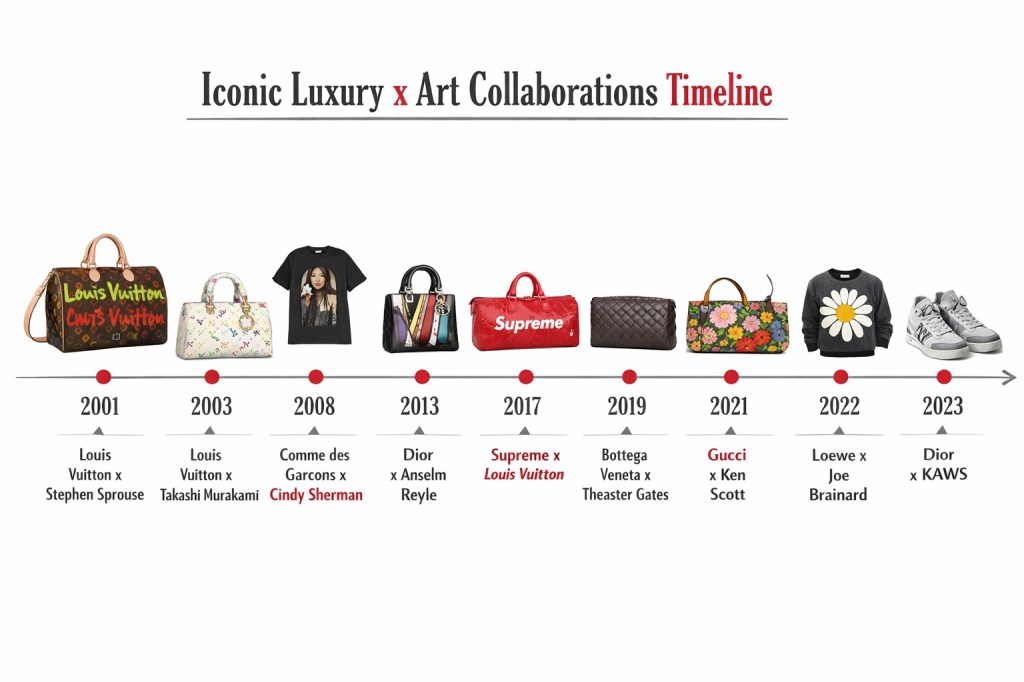
Today, however, the market context has dramatically shifted. Macroeconomic instability, inflationary pressures, and a softening in key regions such as China have made the industry more cautious. In this environment, the experimentalism that once defined collaborations is being replaced with consolidation. Houses are turning inward, reasserting heritage codes and brand DNA over outward-facing creative risks. This is not just financial prudence; it is a cultural recalibration.
Consumers, too, have evolved. The millennial and Gen Z luxury buyer, once enthralled by the spectacle of collaboration, is increasingly attuned to authenticity, sustainability, and brand ethos. In a crowded market, the ephemeral allure of a one-off artist drop no longer holds the same weight. What resonates now are brands that offer continuity, narrative depth, and emotional connectivity. The experience of luxury is less about novelty and more about meaning.
There is also a growing institutionalization of art engagement. Rather than integrating artists into product pipelines, luxury conglomerates now prefer to operate as patrons. LVMH’s support of the Fondation Louis Vuitton, or Kering’s sponsorship of exhibitions at the Palazzo Grassi, exemplify this shift. Art is still part of the luxury ecosystem, but it is now mediated through curation, architecture, and philanthropy rather than through direct collaboration.

This turn to institutional patronage is double-edged. On one hand, it lends credibility and cultural weight to the maisons’ identities. On the other, it renders the relationship between fashion and art more distant, more formalized. The energy, friction, and risk that once defined artist partnerships have given way to a smoother, more corporate approach to cultural engagement. Art becomes a backdrop rather than a co-creator.
The decline in collaborations also reflects a saturation point. After a decade of relentless partnerships, the format has lost some of its disruptive edge. When everything is a collaboration, nothing feels urgent. Consumers have become savvy to the formula, and the perceived value of these partnerships has diminished. In many ways, the luxury industry is detoxing from its own excesses.
At the same time, a recalibration is necessary. Many heritage houses had stretched themselves thin, diluting core narratives in pursuit of cultural relevance. Now, with financial headwinds and shifting consumer behaviors, there is a return to foundational storytelling. This doesn’t preclude artistic engagement, but it requires a more integrated, less transactional approach, one that is slower, deeper, and aligned with long-term vision.

What we are witnessing, then, is not the disappearance of art in luxury, but a metamorphosis. The industry is in a liminal state, attempting to find balance between cultural ambition and commercial viability. The challenge lies in preserving the spirit of collaboration, its dialogue, its tension, its unpredictability, without losing sight of identity and coherence.
Ultimately, the retreat from artist collaborations reveals a luxury industry at a crossroads: seeking to reconnect with its essence while navigating a cultural and economic landscape that demands both relevance and restraint. Whether this results in a new creative renaissance or a period of conservative stasis remains to be seen. But what is clear is that the era of the effortless art-fashion union is behind us, replaced by something more introspective, and perhaps more consequential.
 mabou
mabou 
Leave a comment