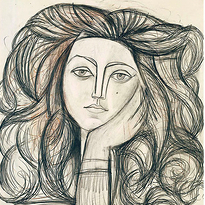
When Agnès Troublé, better known as agnès b., first imagined her fashion label in 1975, she did so with an eye not only on clothing but on culture. Her designs have always been more than garments: they are propositions about how to live, how to move, how to see. Hers is a fashion deeply attuned to the world around it: politically conscious, artistically engaged, and quietly radical in its refusal to yield to commercial spectacle. From the beginning, agnès b. carved a path apart, offering a subtle, utilitarian chic infused with personal conviction and creative freedom.
Her connection to art has never been performative. Before fashion, she studied at the École du Louvre, and that early proximity to painting, sculpture, and museology has never quite left her. In 1984, she opened Galerie du Jour in Paris, giving space to then-marginalised artists such as Futura 2000, Jean-Michel Basquiat, and Nan Goldin. Later, with La Fab., she institutionalized her commitment, bringing together art exhibitions, archives, and her philanthropic foundation under one roof. It is a brand for which art is structural, foundational, and existential.
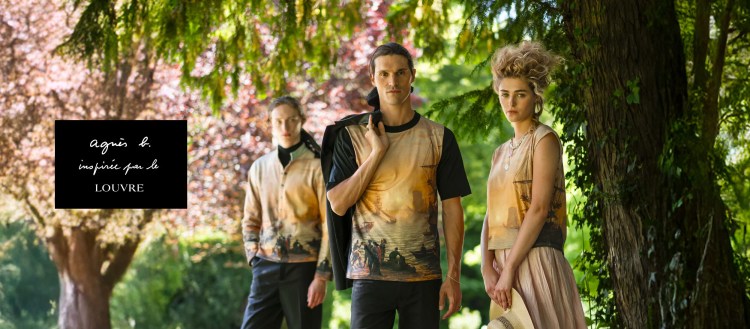
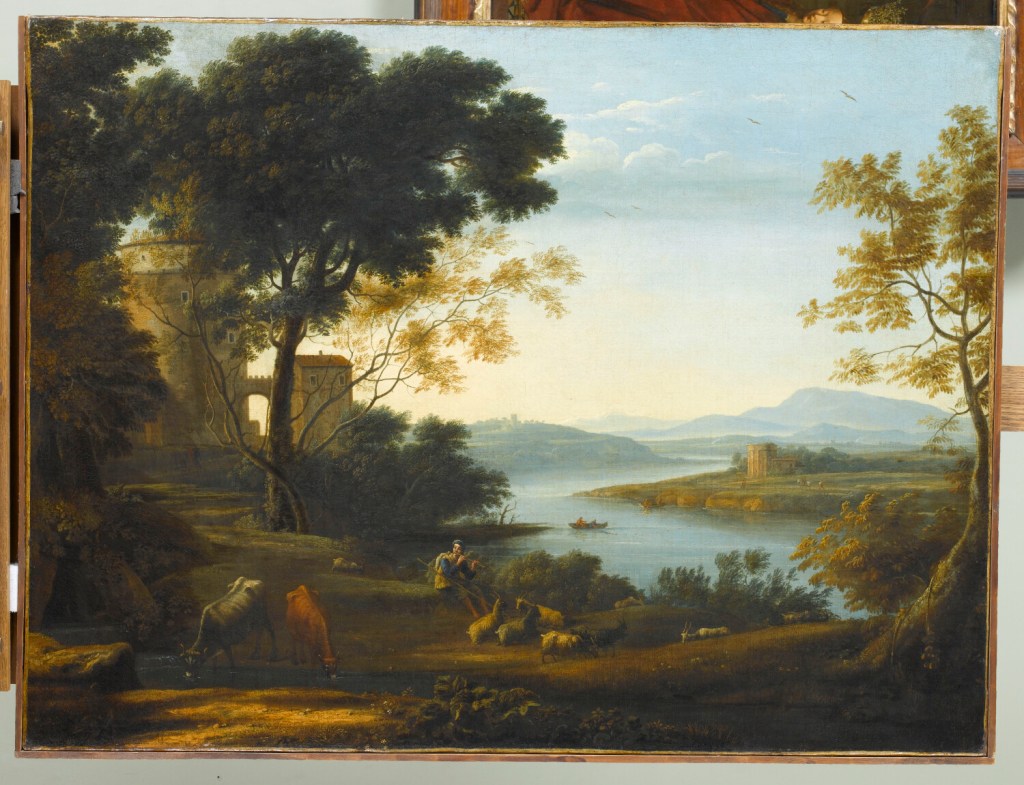
It is within this context that her latest collaboration with the Louvre emerges as a confluence of shared language and legacy. The capsule collection, unveiled in November 2025, draws inspiration from two 17th-century paintings by Claude Lorrain, both in the museum’s collection. Seaport at Sunset and Landscape with Shepherd are landscapes of light and atmosphere, works that articulate time, distance, and human scale with quiet precision. agnès b. transforms them into textiles, using her own photography layered on garments, translating painterly nuance into material form.
This collaboration arrives at a moment of mutual reflection. For the Louvre, it is part of a broader strategy to engage contemporary audiences through brand partnerships, a practice it has explored in recent years with Uniqlo, Swatch, and even Lancôme. For agnès b., 2025 marks fifty years since the founding of the brand, a natural juncture to articulate its enduring values and re-engage its cultural lineage. In this way, the capsule is both commemorative and forward-facing, a moment of pause and a gesture of motion.

Yet what distinguishes this project from other fashion–museum tie-ins is its restraint. There is no loud branding, no spectacular reinterpretation, no ironic twist. Instead, there is a kind of reverent intimacy: the garments do not shout about art; they carry it, quietly. The clothing becomes a surface of reflection. In an age of overexposure, this soft-spoken approach feels refreshing and necessary.
It would be easy to categorise this as just another example of luxury leveraging heritage for cultural capital. But the sincerity of the execution, and the personal history of the designer, complicates such a reading. agnès b. does not borrow credibility from the Louvre; rather, she returns to it, as one might return to a formative influence or an early love. There is something deeply circular in this gesture: the student of art history now engaging with the museum not as visitor, but as collaborator.

For the Louvre, the collaboration extends its reach without compromising its authority. It signals a new kind of institutional permeability, a willingness to let art travel beyond its walls and into daily life. This is not a museum simply licensing images; it is engaging in a dialogue about how artworks live in the present. By choosing Claude Lorrain, a painter of timeless, fictional landscapes, it also subtly repositions the museum not as a relic, but as a repository of eternal questions: of time, beauty, nature, and human passage.
What we are seeing here is less a commercial venture than a cultural translation. The paintings are not printed as images, but felt as moods, atmospheres, and textures. The clothing becomes a continuation of Lorrain’s practice, a play of light and fabric, of movement and stillness. This is fashion as homage, not appropriation; as interpretation, not product.

In the broader landscape of fashion–museum collaborations, this one feels unusually grounded. It does not rely on spectacle or celebrity, nor does it attempt to make the museum “cool.” Instead, it trusts the intelligence of its audience. It speaks in quiet tones, offers historical depth, and invites a slower kind of engagement. In doing so, it reaffirms both the relevance of the museum and the distinctiveness of the brand.
Ultimately, the agnès b. × Louvre collaboration is less about what’s new and more about what endures. It reminds us that fashion can still be thoughtful, that heritage can still be activated without being commodified, and that cultural institutions can extend their reach without losing their soul. In a marketplace crowded with noise, this kind of clarity, poetic, precise, and patient, is more than rare. It is essential.
 mabou
mabou 
Leave a comment