
In Milan these days, Giorgio Armani’s passing has cast a quiet pall over the city’s fashion consciousness, yet two exhibitions now underscore the power of his absence by submerging his work in stillness. At the Pinacoteca di Brera and at Armani/Silos, the designer’s pieces are presented as interrogative presences. Logos are near‑absent; wall texts are minimal; instead, each garment is offered up as a singular object of attention. In those galleries, one finds not the urgency of branding but the gravity of cloth, form, and color.
It’s an unusual moment to consider Armani, precisely because he departed in an era saturated with visual noise, branding gestures, and luxury fatigue. The timing of these shows turns them into elegies, but also into manifestos: fashion unadorned, stripped of narrative, speaking only through its own material presence.
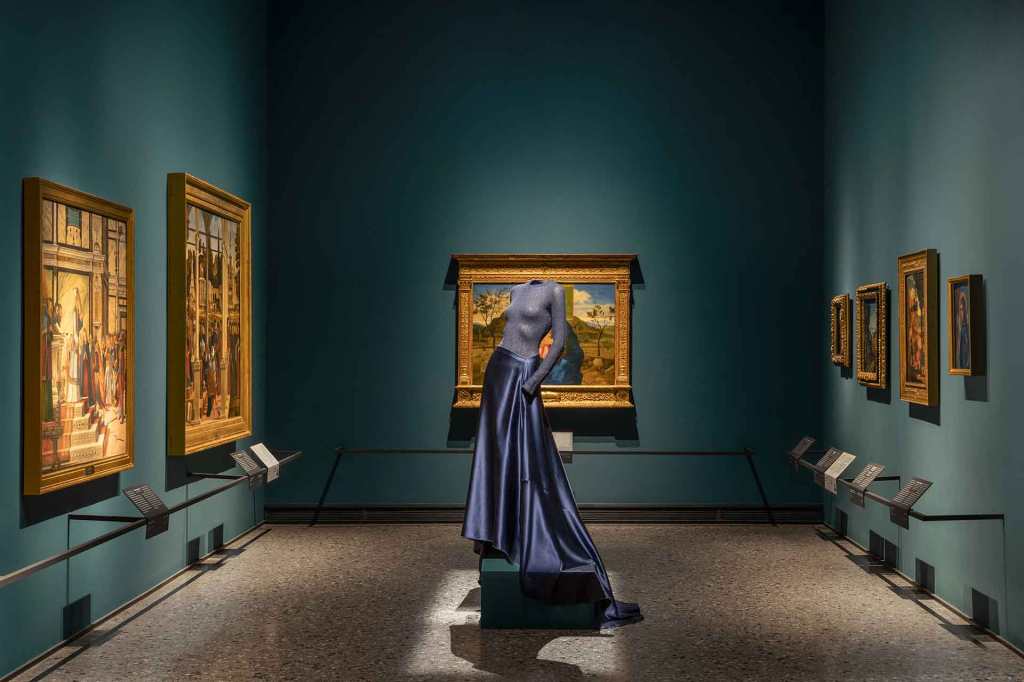
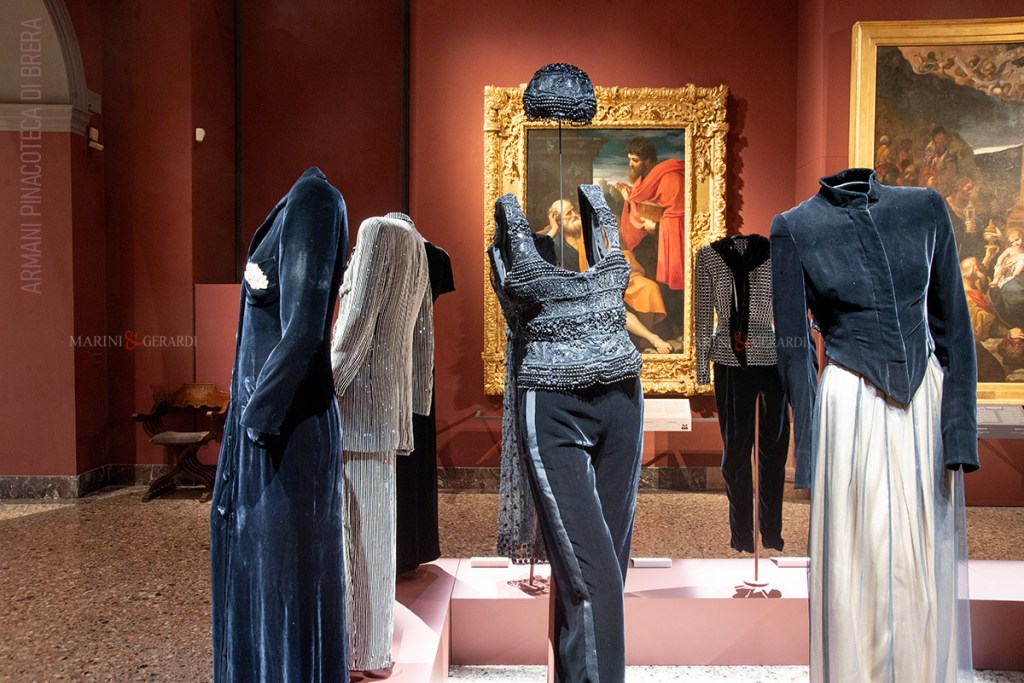

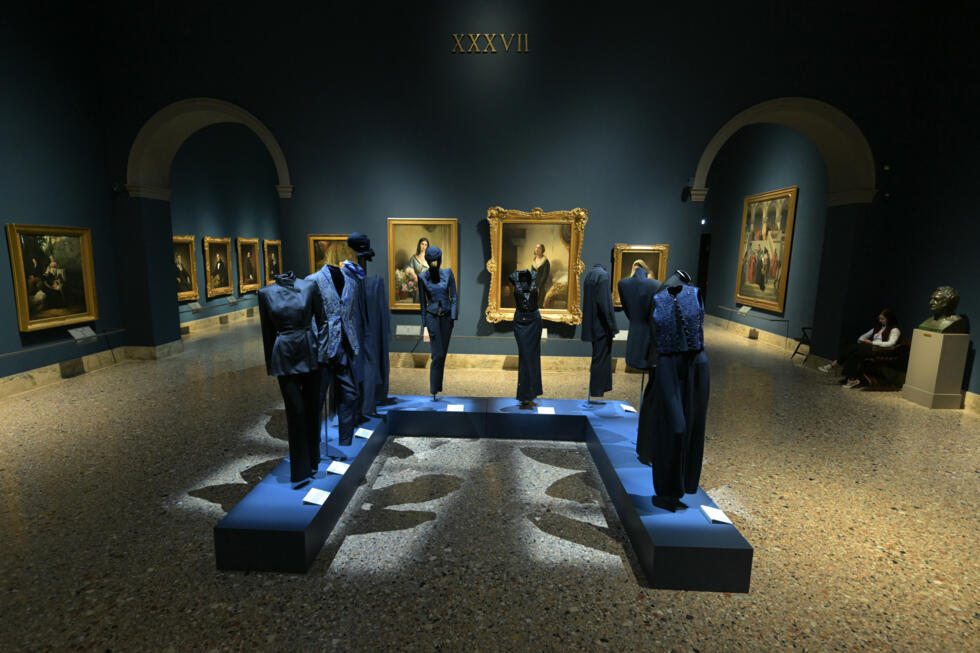
The Brera exhibition, titled Giorgio Armani: Milano, Per Amore, is less a retrospective than a dialogue, a placement of over 120 garments amid the storied rooms and paintings of the Pinacoteca di Brera. The curatorial logic is subtle and synesthetic: garments are positioned so that the palette and mood of the surrounding walls and frescoes seem to echo into the clothes themselves. In some rooms, velvet midnight blues bleed into the shadowy tones of adjacent canvases. In others, monochromes, chalk, ivory, smoke, are paired with backdrops that diffuse rather than spotlight. The effect is deeply immersive, yet almost anti-theatrical.
As reported by The Associated Press, the exhibit resists hierarchy, there is no clear chronological order or categorization by function. Instead, color becomes the implicit logic. Armani’s signature restraint unfolds across chromatic chambers: black evening wear dissolving into shadow, silver lamé capturing a flicker of historic gilt. The fashion is not in competition with the art, it becomes an extension of the gallery’s tonal rhythm.
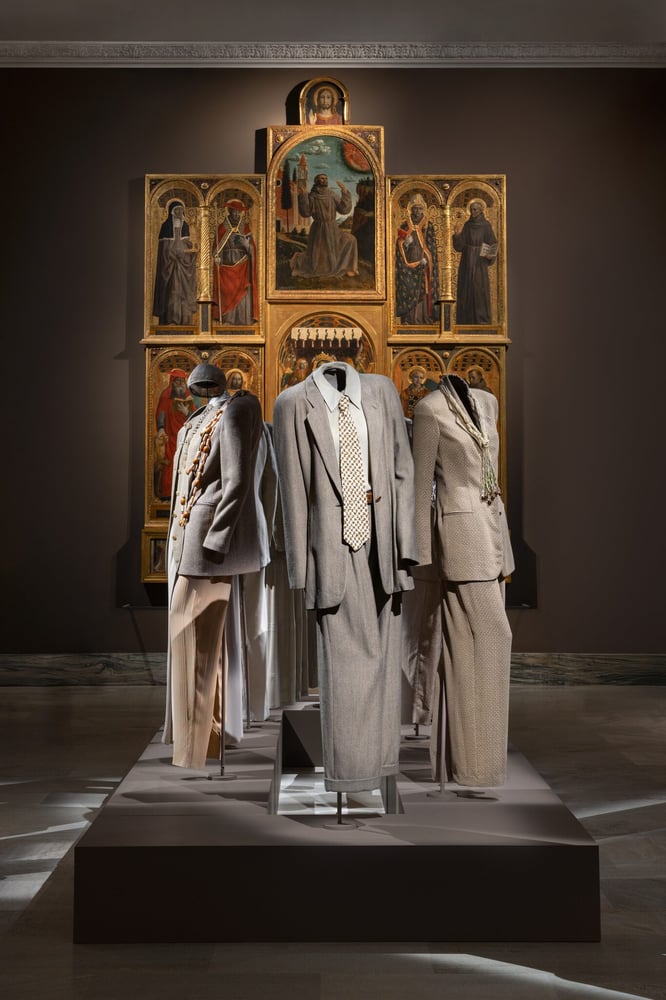


Remarkably, there is almost no textual guidance. No plaques, no audio guide, no timeline. The viewer must work for meaning, or surrender to atmosphere. Out of 120 garments, only one logo is visible. This is deliberate. It withholds brand recognition in favor of silhouette recognition, form recognition. One begins to see the clothes less as identifiers of taste and more as expressions of tension, release, volume, and movement.
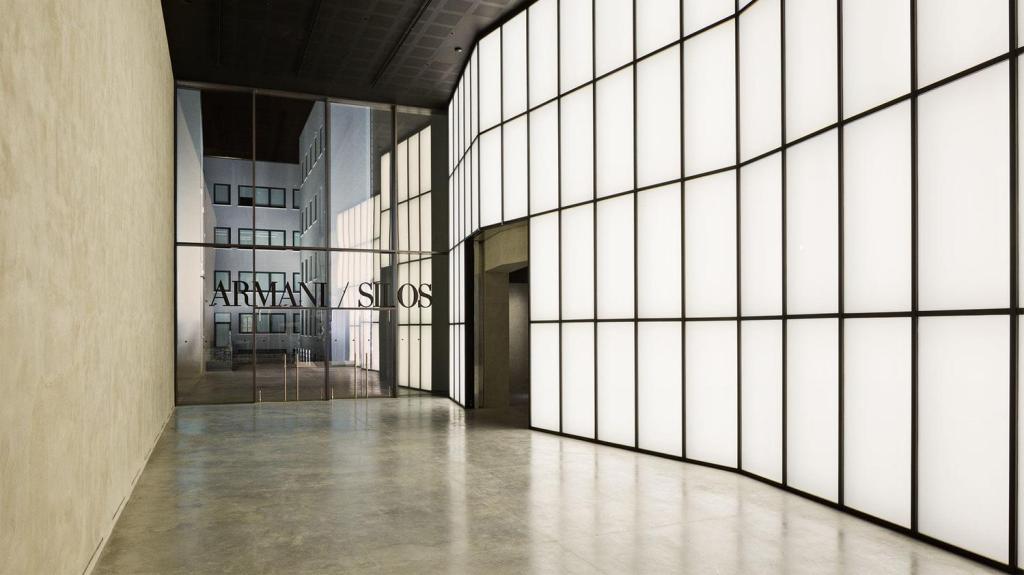
At Armani/Silos, the presentation is equally restrained but more architectural. The space, formerly a granary converted into the house archive, is organized across four floors, currently home to Armani Privé 2005–2025, a survey of two decades of haute couture. Here, garments are arrayed not by chronology or theme, but in constellations of craft and atmosphere. Dense embroidery, translucent layering, and textile experiments are grouped so that material, not message, leads.


The building itself enforces a kind of aesthetic discipline: raw concrete floors, matte walls, a monochrome shell that recedes so the garments may advance. There is a severe beauty to this: a black sequined column gown hovers under stark spotlights; a pale organza jacket seems to float, freed from gravity by the quietude of its setting. You notice the inner structure of these clothes, how linings are anchored without seam bulk, how shoulder volumes are controlled without padding. It is as if the very engineering of elegance is being reverse-engineered for the attentive viewer.
What unites both exhibits is the notion that fashion can operate in the register of sculpture. There is little in the way of contextual placards or moodboard-style collateral. No celebrities, no lookbooks. Just garments as thought-objects. The only narrative is material: silk versus wool, sheer versus matte, structure versus collapse.


And what is most striking, especially in Armani’s absence, is how these presentations reject the grammar of luxury-as-status. In an age where branding is the currency of recognition, Armani’s ethos now feels radical: almost no logos, no slogans, no need to shout. His clothes whisper with conviction, not submission. They are designed to be worn, yes, but also to be seen on their own terms, to articulate form through fiber, rather than through fame.
As luxury fashion begins to reel under the weight of its own maximalism, its logos, its capsule drops, its viral collaborations, these exhibitions operate as a quiet rebuke. Not retrograde, but timeless. Armani’s vision, always steeped in restraint, now reads as prescient. At a time when even the most discerning consumers are questioning the cost, pace, and purpose of luxury, his language of material clarity and functional grace appears more vital than ever.


There’s something almost posthumously utopian about this dual showing. Neither museum feels like a mausoleum. Rather, they function as spatial essays, demonstrations of what fashion can still do when it trusts the intelligence of the garment and the eye of the viewer. In withholding narrative, they make room for attention. In withholding logos, they make room for form. What remains is not nostalgia, but proof: the work holds.
 mabou
mabou 
Leave a comment