One of the blockbuster exhibits of this Spring-Summer in Paris is the exhibition of the works from the collaboration between Andy Warhol and Jean-Michel Basquiat at the Fondation Louis Vuitton, titled “Painting Four Hands”. While it is common knowledge that both artists evolved in the same circles of the underground scene of downtown NYC at the end of the twentieth century, the extent of their collaboration, particularly during 1983-1985, probably never received the form of institutional intention the Fondation gave it.
To start off, let me stress that since opening in 2014, the Fondation has proposed some of the best exhibitions season after season, from subject to curation to mediation, it has established itself as one of the critical cultural centers of the French capital. Yet, this must be the first time I am genuinely deceived about my visit. Indeed, despite the valuable art historical insights and the qualitative curatorial work, I cannot get around the fact that the works exposed are not that interesting, and the tentative of the Foundation to justify the questionable quality of the two artists’ collaboration feels like a strategic positioning aiming at justifying their own commercial strategies at Louis Vuitton and some of the other brands of the LVMH conglomerate.

From “Keys to a Passion” in 2015 to “Icons of Modern art. The Shchukin Collection” in 2016-2017, “Being Modern: MoMA in Paris” in 2017-2018, Jean-Michel Basquiat and Egon Schiele in 2018, “The Morozov Collection. Icons of Modern Art” in 2021-2022 and “Monet-Michell” in 2022-2023, the Fondation Louis Vuitton has been instrumental in bringing important works of modern art scattered around the world to Paris – sometimes for the first time ever -, with a focus on Russia – before the invasion of Ukraine – and the United States.
Over the years, the foundation has also developed one of the best cultural mediations of the capital, with free mini-tours every half hour across 3 of the 4 levels of the building designed by starchitect Frank Ghery. Long-story short, I have mostly been extremely impressed by my visits there, always learning something new and seeing exceptional works of art I would maybe never see again in my life, not only because most of these were in museums abroad, but also in private collections not always disclosed.

But this time, I have little compliments to give to the Warhol – Basquiat exhibition. Or maybe the fact that the work of Basquiat, often crowded and hard to decipher because full of multilayered messaging and symbols, felt more digestible since he had to share the space with Warhol, making it sometimes more convincing. Let me be clear that I love the work of both artists, they have strong universes and powerful, multifaceted visual languages.
Warhol is famous for his criticisms of the American consumer society, his obsession with fame and his use of the serigraphy technique to summarize grossly. Basquiat started his career in the world of street art before moving to canvases and rising to fame. As a young African-American, his artistic legacy is replete with engaged messages referring to his heritage and the status of his community in the racist American society he evolved in.
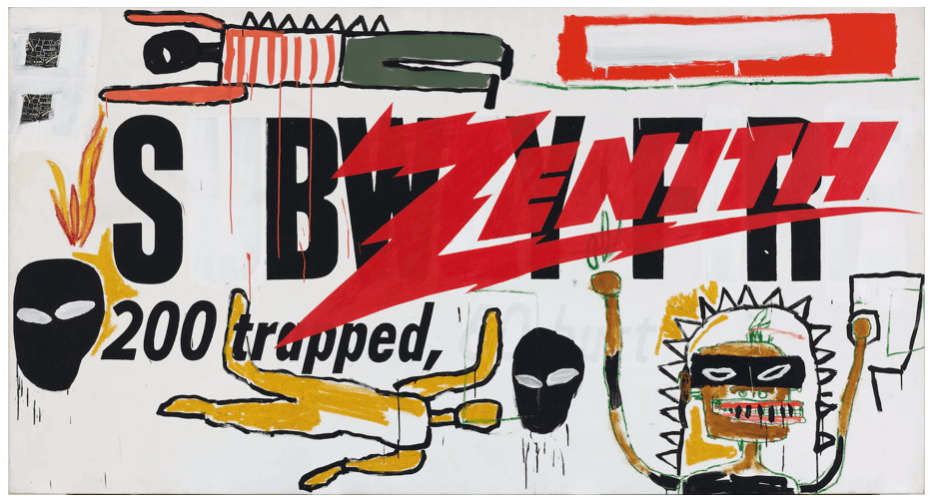
© Estate of Jean-Michel Basquiat Licensed by Artestar, New York, © 2023 The Andy Warhol Foundation for the Visual Arts, Inc. / Licensed by ADAGP, Paris Credits : Courtesy of Zidoun-Bossuyt Gallery, Luxembourg
The goal of the collaboration between those artists, which was orchestrated by their gallerist Bruno Bischofberger, was to merge the two artist’s methods, subjects, and unique artistic signatures to create a third degree of creation: the collaboration. “Keith Haring (1958-1990), who witnessed their friendship and collaboration production, would go on to speak of a “conversation occurring through painting, instead of words,” and of two minds merging to create a “third distinctive and unique mind.””, stresses the website of the FLV. Additionally, “I think those paintings we’re doing together are better when you can’t tell who did which parts” said Andy Warhol.
Along the exhibition, the curation and the mediation tries to convince us of the success of the enterprise in creating a thirdly distinctive style. But, looking at the 80 pieces presented, half of the total number the artists created together over the period, I cannot see one painting where this merging successfully materializes. This applies not only to the style: we can clearly see who did what, but also the method: there are a few pieces where the artists exchanged medium (acrylic/serigraphy), which are fairly among the most interesting, but they mostly stuck to their own thing.

stamped with the Estate of Andy Warhol and the Andy Warhol Foundation for the Visual Arts, courtesy Christie’s
Most importantly, it applies to the message: we are not sure what the artists are trying to get across, they are each repeating some of the tropes they are obsessed with but it feels like they haven’t discussed how these relate to each other in order to say something different or new, that is, coming from a third brain. They share the space of the canvas half/half, but they do not share a voice.
In some ways, it feels like the Foundation is trying to help justify some of the strategies put in place by the LVMH brands, namely, their own collaborations with artists. Quite paradoxically, the fondation acknowledges that a successful collaboration is not the simple addition of two artistic universes set side by side to create merely a mix and match, but the active collaborative production of something new. But the way they illustrate this is a failure. Yes, they are taking two of the most important artists of the second part of the 20th century, if not of Art History, but their collaboration is anything but successful according to the terms defined by the curators and the FLV themselves!

© Estate of Jean-Michel Basquiat Licensed by Artestar, New York, © 2023 The Andy Warhol Foundation for the Visual Arts, Inc. / Licensed by ADAGP, Paris Credits : Courtesy Nicola Erni Collection, © Reto Pedrini Photography
If the collaboration was that short, it is because the critic was extremely harsh in 1985 at the opening of their duo show, especially with Basquiat, who was described as a puppet for the 30 years older Andy Warhol. Subsequently, these paintings did not gather that much institutional attention and even, do not seem to enjoy the success individual Warhol and Basquiat pieces enjoy. Half of the pieces exposed are in private collections and half are still in Bischofberger collection/estate, none seem to be in public collections. Why is it the case? I do not know, I am not aware of the behind the scenes forces around the attribution of the pieces from this collaboration and even the interest of Bischofberger in parting ways with them, but my take is that it is because they are underwhelming.
Probably as underwhelming as the latest Louis Vuitton collaboration with Yayoi Kusama. This collaboration seemed to add Kusama’s universe and key symbols to Louis Vuitton items and voilà, here is a new super interesting collaboration, claimed the brand. Clearly, there are similar dynamics going on with the Warhol-Basquiat collaboration, but LVMH is trying to frame this historical endeavor as a striking success, while it was not, probably for very relevant reasons.
 mabou
mabou 
Leave a comment