For Fall Winter 2022, the designer Stella McCartney was inspired by the work of American artist Frank Stella. Aptly titled STELLA by STELLA, underlying the collaborative nature of the collection, the latter features several pieces directly inspired by the work of the 86 years old artist. In fact, he approved each and every one of the designs that eventually made it to the collection. More than an homage to the style and impeccable taste of the artist, the collection adds a layer of identity to the Stella McCartney woman: she shines through bold opposites, whether in one’s career, styles, or one’s personality. The Stella McCartney woman, like her style, is full of contradictions and that is what makes her interesting.

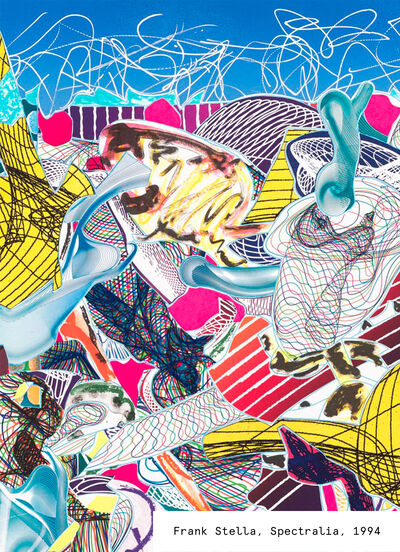


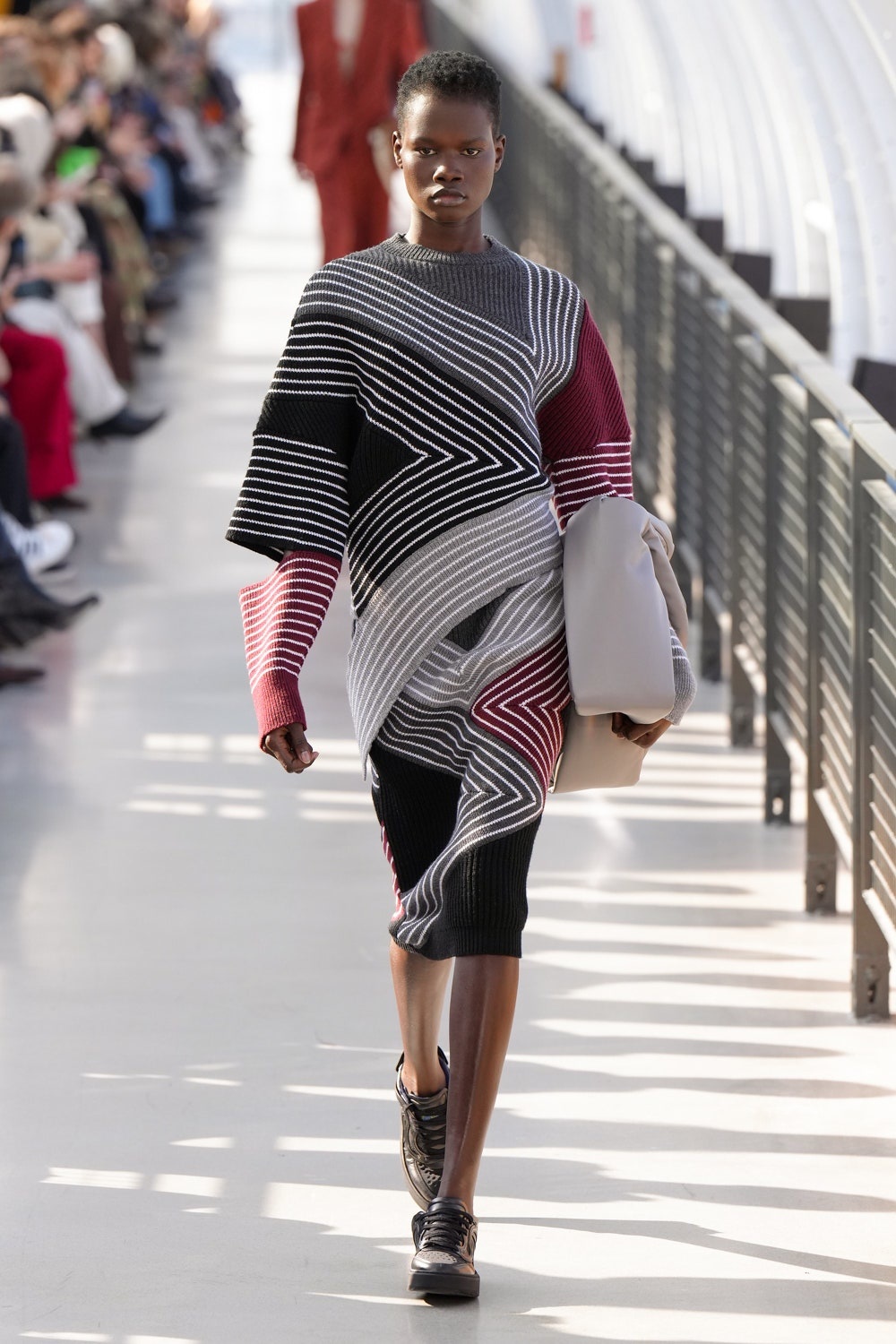
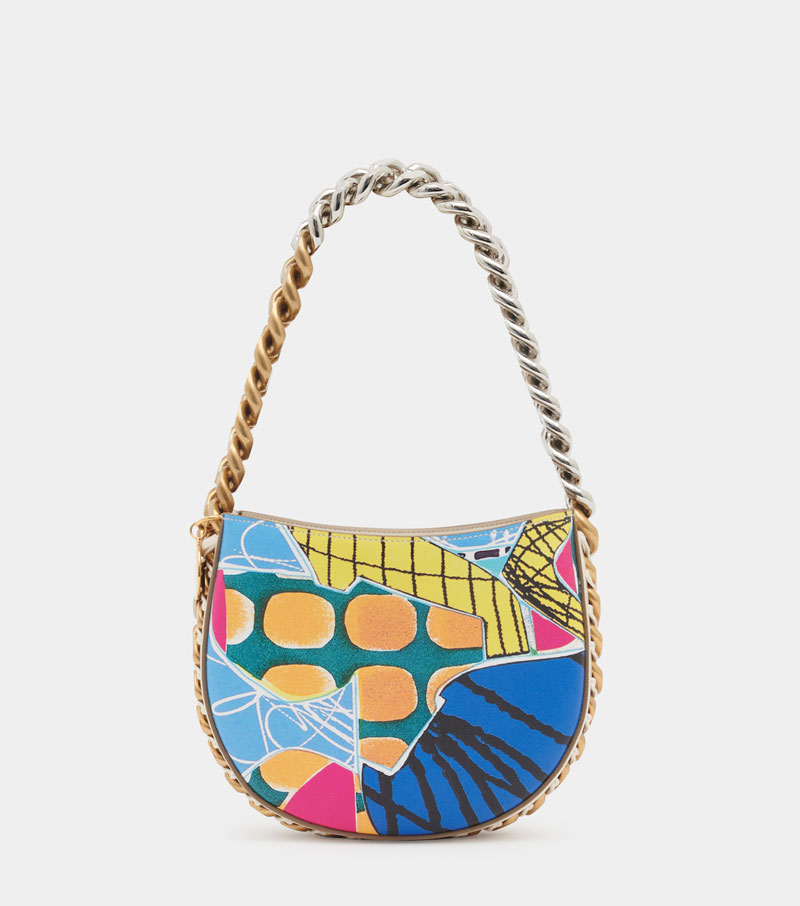
Several of the pieces feature prints from some of the most recent artworks, allowing for bold statements like a dress and a bag featuring Spectralia (1994) and another dress with Ahab (1985-1988) printed all over. The Swan engraving series allows for an investigation of depth in prints and looks like optical illusions on which the eye is invited to wander without ever settling. Other pieces ingeniously use his earlier geometric works and his distinctive use of lines to collapse the traditional plans of a painting, thereby creating an optical illusion though 3D clothing. The sharp lines of the label’s suits perfectly combine with the V Series (1968) paintings of the artist.
Frank Stella is one of the most important American artists of the second part of the 20th century and his work continues to influence the contemporary artistic creativity of which Stella McCartney’s collection is an example. If it is impossible to encapsulate the complexity of Stella’s (the artist) creation in terms of evolutionary duality, his work is notably distinguished by an embracing of Minimalism as a reaction to abstract expressionism followed by an involvement with Maximalism.


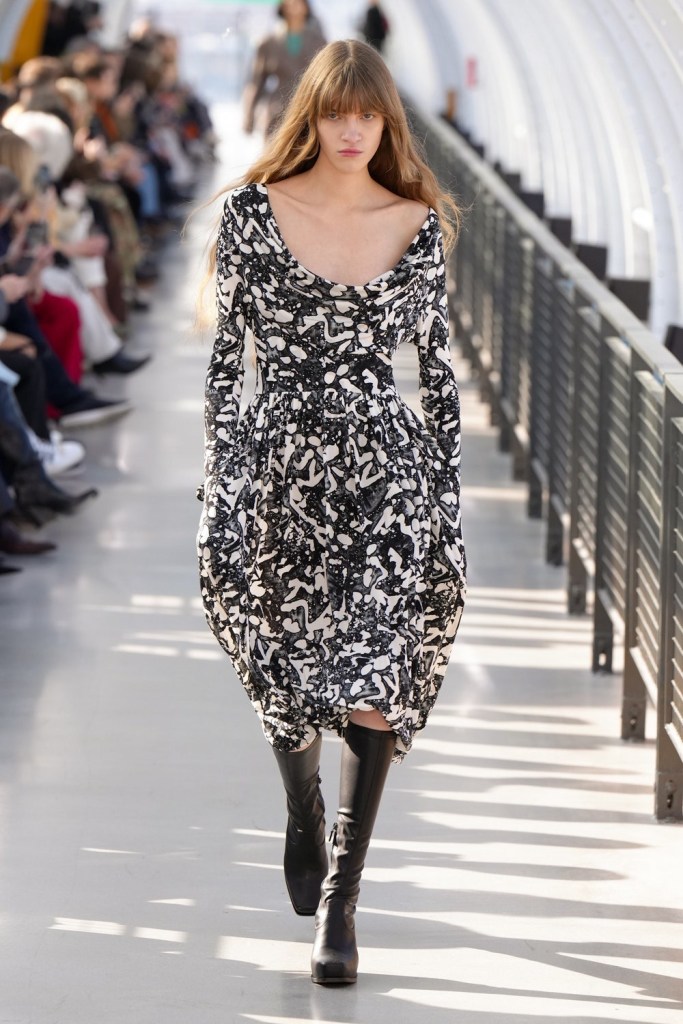
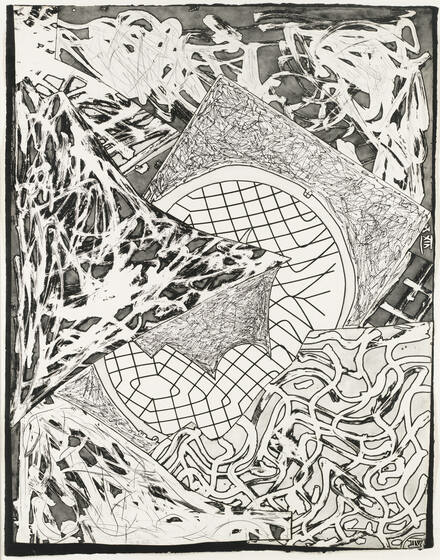
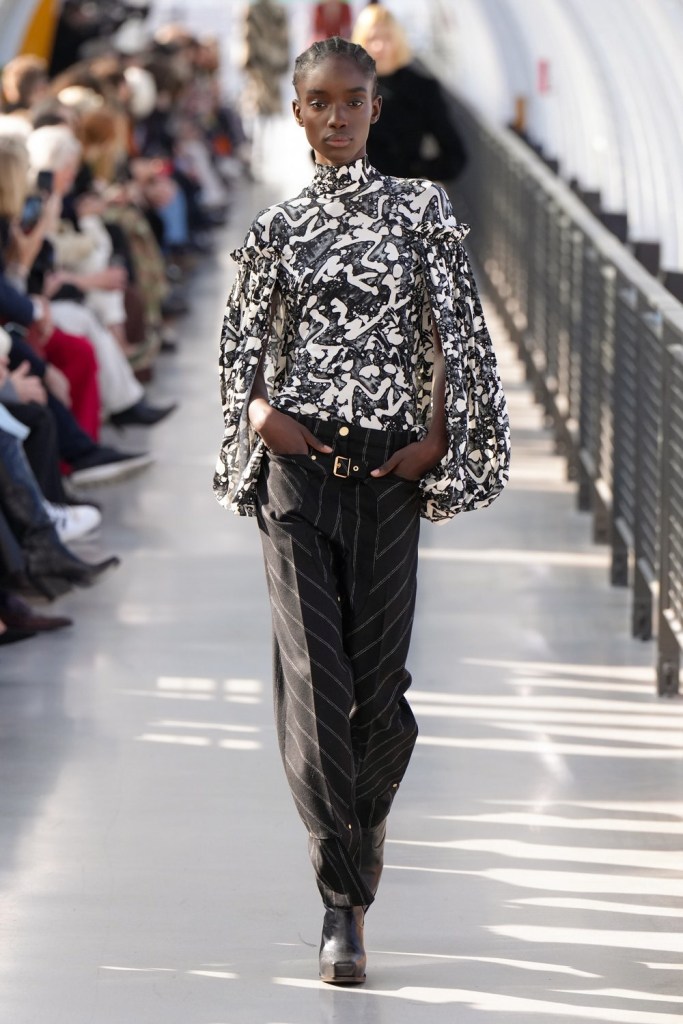
The artist moved to New York in 1958 after attending Yale University and gained recognition very early on. In New York, he was influenced by the work of Jackson Pollock but was inspired by artists like Barnett Newman and Jasper Johns who focused on one-dimensional flat surfaces. Frank Stella was interested in the picture-as-an-object paradigm, where abstraction ought not to represent anything in particular, nor reference emotions or familiar elements. The painting was “a flat surface with paint on it – nothing more” according to the artist. This is the period of the Black paintings series of which Die Fahne Hoch! (1959) is an example.
During this time period, he experimented with geometrical shapes and canvases in the form of T,U, or L in typically minimalist fashion. “Minimalism is an extreme form of abstract art developed in the USA in the 1960s and typified by artworks composed of simple geometric shapes based on the square and the rectangle“ according to the Tate Museum. He also introduced colors and methodical superpositions of circles, arcs and squares referencing circular Middle Eastern cities like in Harran II, 1967.


Interestingly, in 1967, he designed the set and costumes for Scramble, a dance piece by Merce Cunningham as a first foray into the intersection of art and fashion, in which he was already interested thanks to his mother. “My mother was very interested in fashion as well as painting. She studied fashion and design in school in Boston before she retired to keep house and raise children. When she dressed up, she was glamorous.” the artist said in an interview with Stella McCartney.
During the 70s and 80s, Stella started to include dimensionality in his works, in what he came to call Maximalism – referencing the sculptural quality of his works – of which the Eccentric Polygons series is part. Quite interestingly, in the opposite, what drove interest to his earlier works was the lack of depth that came to characterize his art. During this period, he started experimenting with materials like plywood and aluminum and his canvases took even more irregular shapes as he started making large metal sculptural pieces. Interestingly, “This collection was a lot about bringing new fabrics and textures to our brand” said McCartney echoing the evolution of the creative process of the artist. His prints of this period, used as an inspiration by McCartney, included several techniques of print and drawing-making.


Since then, his work has evolved towards more three dimensionality while still referencing geometrical shapes that became more elaborated including “cones, pillars, French curves, waves, and decorative architectural elements”, as well as graphic shapes that are used as prints by McCartney. A large body of the works he produced in the 1980s was inspired by Herman Melville’s Moby Dick, instilling some meaning in works that previously had deliberately no particular sense.
Since then, he keeps reinventing his previous references and exploring areas that have made him famous, exhibiting a constantly evolving relationship with his current and previous works and the complexity of his artistic endeavor. While the V Series of his early years was primarily concerned with flatness, they are imbued with a new meaning by being used on three-dimensional clothes, that come to life on moving bodies and share more similarities with sculptures than flat paintings. In this manner, the minimalism of his beginning is put in direct conversation with the maximalism of the 70s that he seems to have tried to reconcile in the latter years of his career.
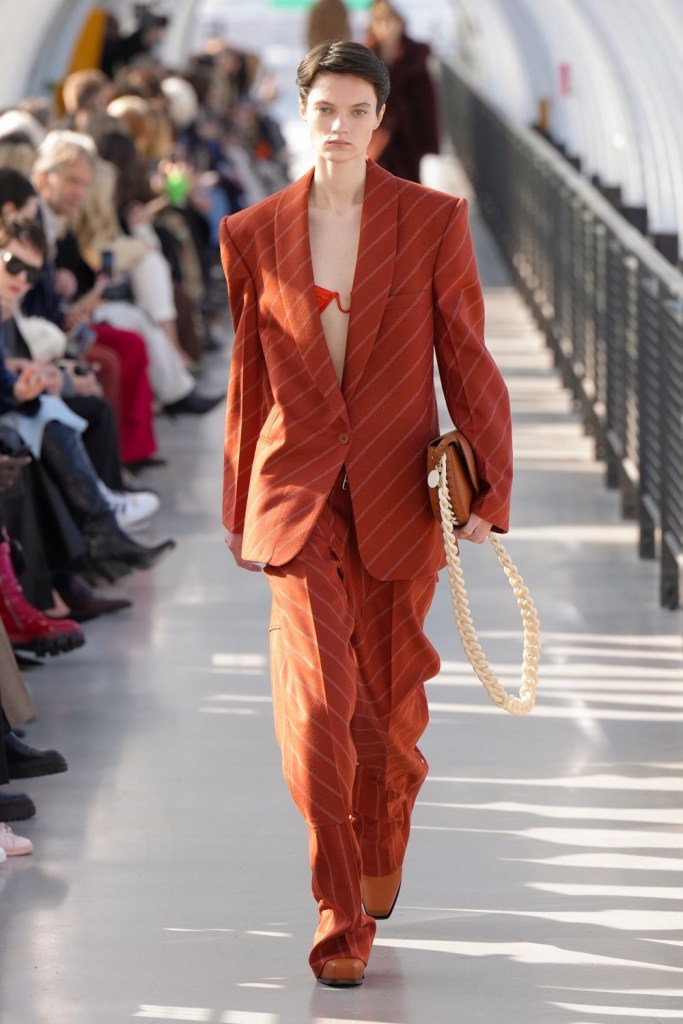
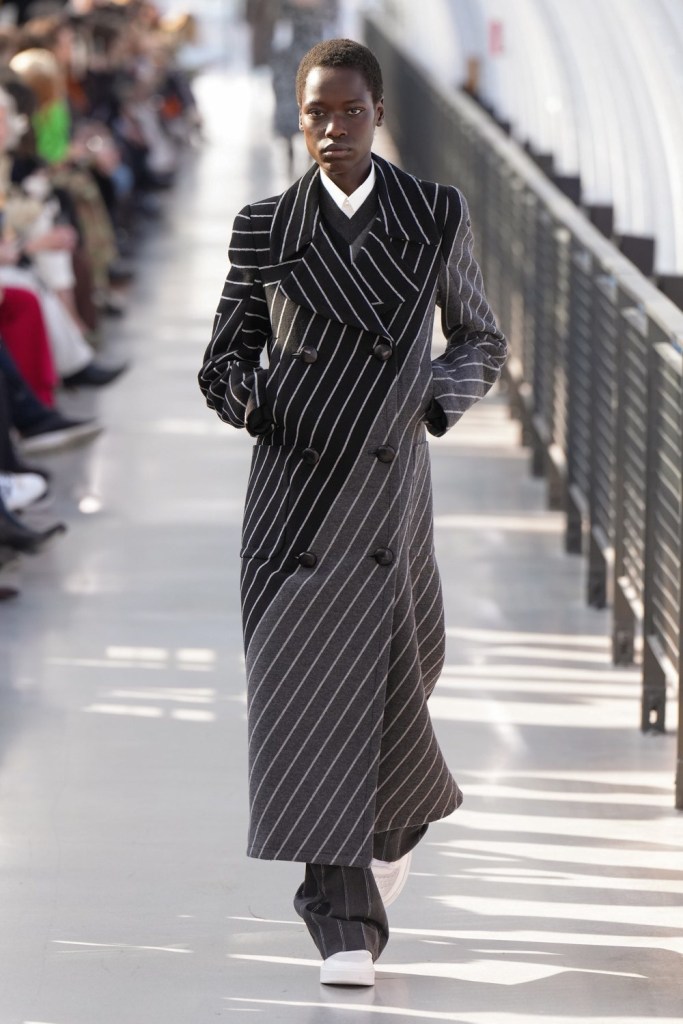

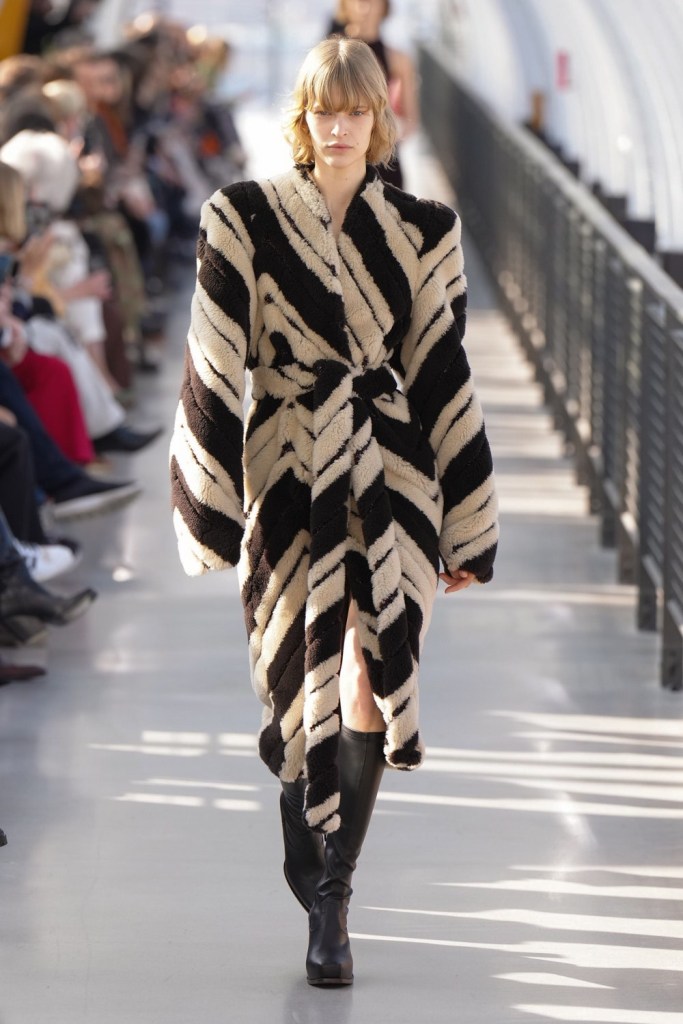
What makes an artist’s career interesting is the evolution of the relationship between the different interests and subject matters investigated by the artist. They exhibit the contradictions and multiplicity of mediums, subject matters, and inspirations, while often being driven by a similar purpose – the artists’ unique point of view. In the same manner, what makes one’s style, and even one’s outfit really interesting, is the combination of different pieces that go together because they clash with each other.
Interestingly, the brand, by putting in conversation pieces from different time periods and different movements in which the artist took part not only acts as a curator, but also sheds light on the extent to which earlier works resonate with later ones, underlying the idiosyncrasies and disjunctions in the artist’s works. More than a continuum of evolution, Frank Stella’s career is defined by a constant reinterpretation of key tropes without giving them an arch or a hierarchy. At the same time, the eclectic fashion looks reflect the plurality of the McCartney women and the intricacies of their identities.
Therefore, through this collection, Stella McCartney’s brand takes two interesting stances. First, the brand, more than producing clothes (worth mentioning, meaningfully sustainably compared to other luxury players), acts as a curator. By selecting works by Frank Stella and putting them in conversation, the brand takes the role of a museum or art gallery. And in fact, it ostensibly claims so by having had the runway show at Centre Pompidou in Paris, which holds the largest collection of Stella’s works in Europe.
Additionally, the brand claims some similarities with the work of the artist, beyond the visual aspect. By putting in conversation pieces from different creative periods of the artist and giving them contemporary resonance, the brand is giving temporal significance to its collection. It builds from past references anchoring cultural significance and collapses the traditional evolutionary view society tends to have on an artist’s career.
In this manner, the brand asserts their importance as cultural tastemakers and underlines the diversity of the Stella McCartney clients obsessed with both minimalism and maximalism. “The Frayme bag, a new icon and a perfect example of juxtapositions, mixes feminine and masculine energy with an oversized mixed galvanic chain strap and its sculptural lines felt like the perfect canvas for a print inspired by Frank’s work, Spectralia” says the designer. A diversity of profiles but also of facets reflective of the human complexity of her sophisticated clients.
 mabou
mabou 
Leave a comment