
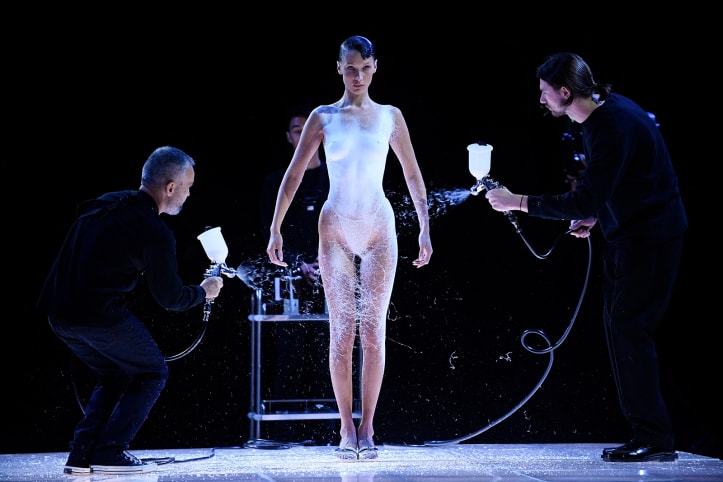
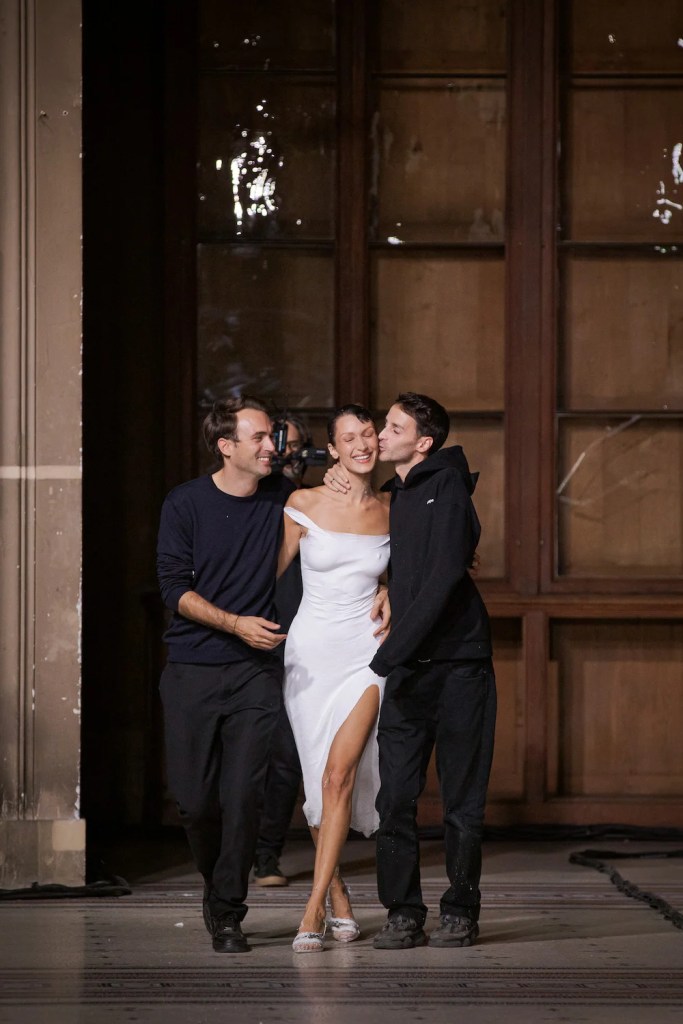
There were undeniably countless gasp moments at this year’s SS23 Paris Fashion Week, for good and bad reasons for that matter. But one of the most intriguing and subversive ones was the finale of the Coperni show that took place on September 30th. For their last look, Sébastien Meyer and Arnaud Vaillant, founders of the label, sent an almost naked Bella Hadid down the runway and served a presentation at the intersection of a fashion show and a piece of performance art.
Fittingly taking place in the Salle des Textiles at the National Museum of Arts et Métiers in Paris, the happening kept the public in awe for more than 8 minutes as the supermodel, wearing only a sheer underwear, was sprayed with a white, fibrous and aqueous misty substance called Fabrican. Developed by Doctor Manel Torres who was among the three technicians on the runway, the patented material made of fibers, polymers and liquid solvents solidifies and dries when it enters in contact with any surface, creating a textile. While initially developed for the fashion industry, it has other applications especially for the healthcare industry for masks or bandages.


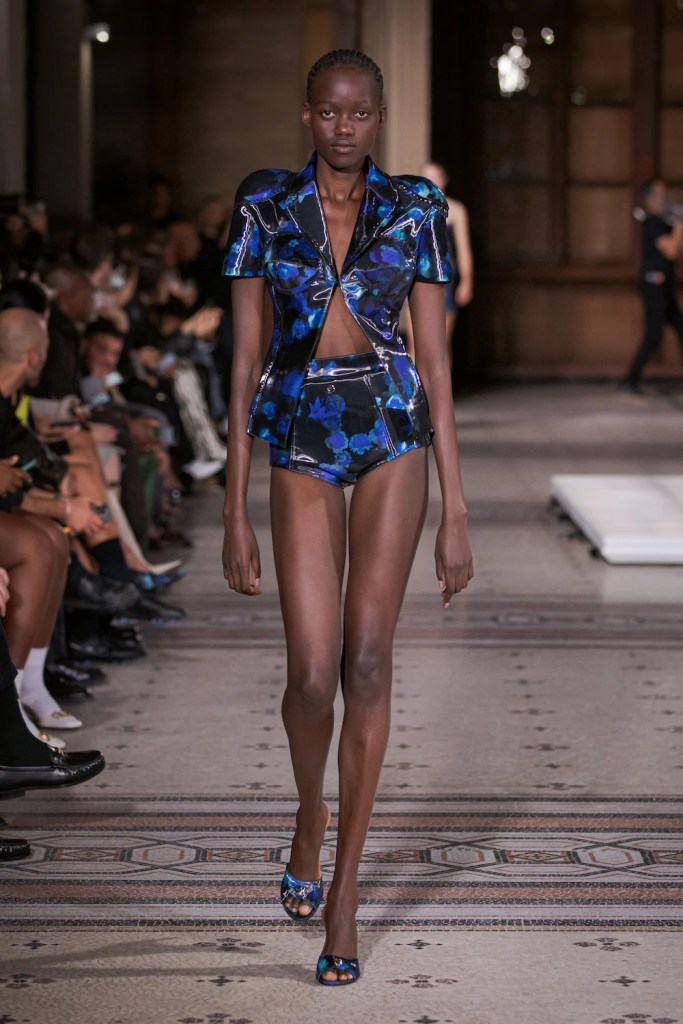
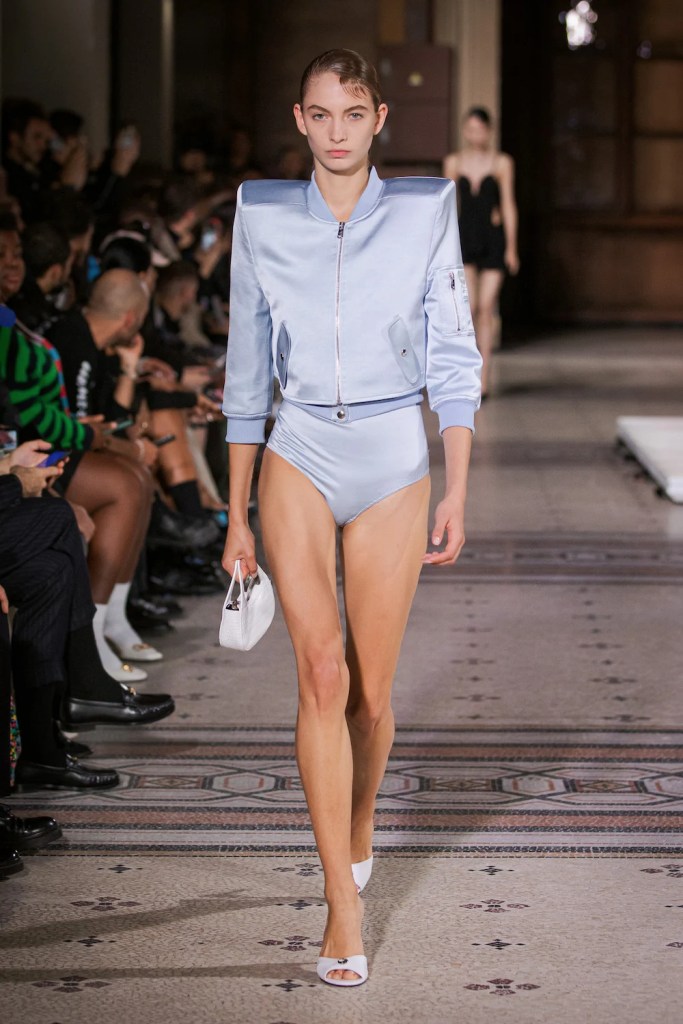
Coperni, named after the Renaissance polymath Nicolaus Copernicus (Copernic in French), has made experimenting with science, materials and technology part of their DNA. Last season, they partnered with Home in Heven to reinterpret their signature swipe bag in glass. This season, they had one made out of solid 18-karat gold, which was then sent back to the artisan Gabriele Veneri to be re-melted and potentially re-made if an order comes in, and Vaillant told Vogue he thinks one will. Some jackets were inspired by Roblox characters, some prints were digitally produced while a red dress was inspired by The Matrix, in a collection dedicated to all the women and experimenting with the relationship between fashion and the evolution of crafts through technology.
After Bella Hadid was sprayed from neck to calves with the white substance, the head of Coperni’s design studio Charlotte Raymond came on stage to shape the sleeves of the dress and cut a deep slit on the left side. The show ended after the model took a last lap around the runway, leaving the audience in awe and slightly in shock of what they had just witnessed. The dress, because of the way it was made, has no hem or seams and looked like a light white jersey. “You can wear this dress, keep it as a dress and put it on a hanger. But if you don’t want it anymore, you can put back the dress into the liquid and you can immediately spray it again,” Coperni’s creative director and co-founder, Sébastien Meyer, told CNN at the brand’s Paris atelier ahead of the show.

Fashion shows are by nature, performances, but the intrinsically time and place dependent nature of a dress being custom-made on the runway gives it a special character. If the presentation was reminiscent of Alexander McQueen’s 1999 runway show where model Shalom Harlow’s dress was spray-painted by robots, the founders stress that this was something utterly different. Sure the process and medium was not the same, but the artistic intention bore some common cues.
The term performance art, coined during the 1970s as artists started to institutionalize experimentations with the temporality of message making through non-traditional forms of art. Performance art includes happenings and pieces of art that are fleeting, which can only be fully experienced once: when they happen in front of a particular audience. According to Tate, performance art includes “artworks that are created through actions performed by the artist or other participants, which may be live or recorded, spontaneous or scripted.”
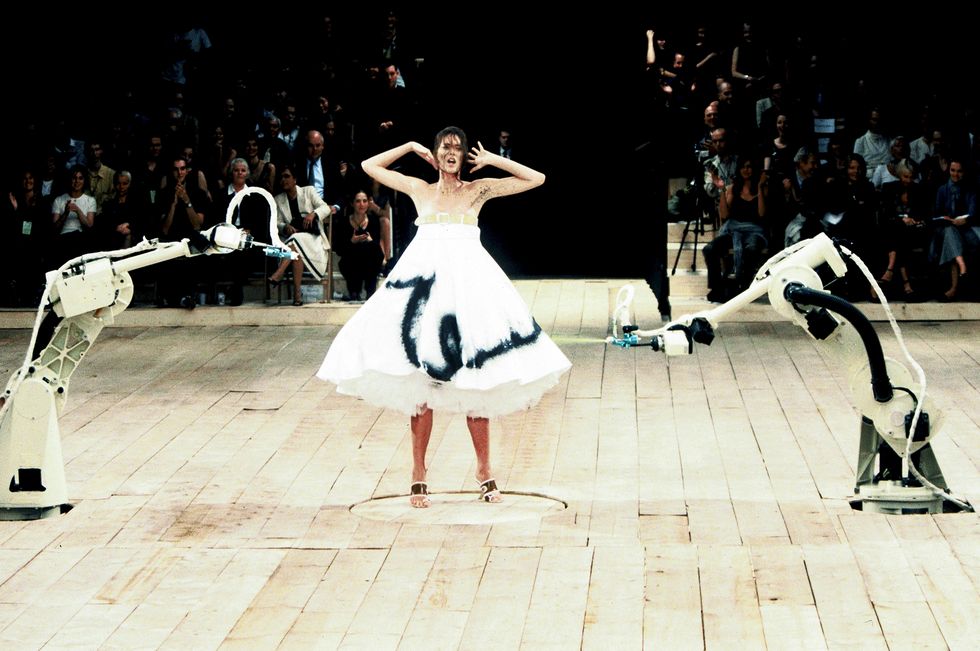
The medium in which they leave a trace, whether it is painting, sculpture, and mainly video, only conveys part of the message and arguably is another piece of art altogether. Bella Hadid posted a photo of the performance captioned “Only together we can make this magic. I am still speechless” and another one with “No rehearsal, no nothing, just passion.”, making the performance even more unique as a characteristic of performance art.
Cuban American artist Ana Mendieta is famous for her exploration of the body in relationship to its natural environment through an expression of her own story as a migrants. In the series Silueta, the imprint of her body on organic surfaces explores the notion of periodicity and transience. It flourished after Abstract Expressionism and was concerned with the performance of the body.
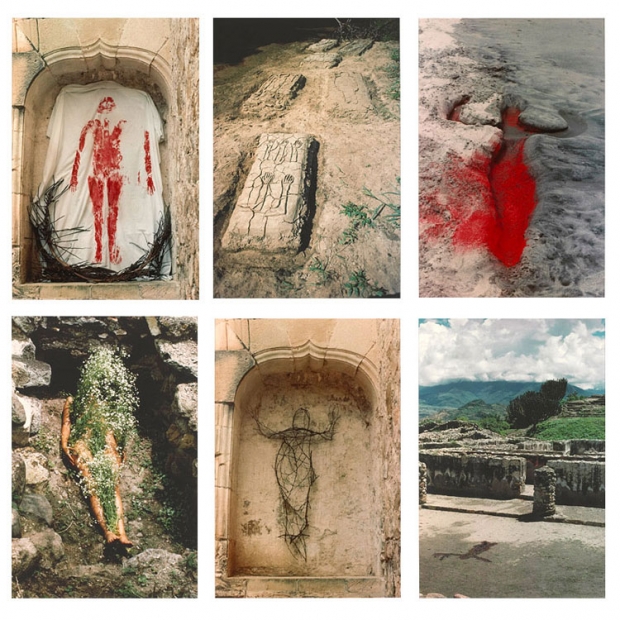
Interestingly, performance became aligned with conceptual art, because of its often immaterial nature. A concept that gains new meaning with the Coperni dress of which the material can be re-bottled and reused, collapsing the material continuity of the piece. The dress was not made for commercial purposes and no such item will be sold by the brand, which makes the last look that was shown something different than the rest of the collection. It is an experimentation with science and technology and the founders underlined they wanted to work with Bella Hadid because of her release of NFTs and her interest in the intersection of fashion and technology.
“Sébastien (Meyer)’s main inspiration is innovation, whether its technology or the digital sphere,” Vaillant said to CNN of his Coperni co-founder. “So he always has this reference.” as a contemporary concern. Performance art is highly tied to a certain moment and place in time, and in 2016, theorist Jonah Westerman remarked “performance is not (and never was) a medium, not something that an artwork can be but rather a set of questions and concerns about how art relates to people and the wider social world”. And in this case, how fashion relates to the current cultural stakes including technological innovation. But above all, the Coperni finale is a moment that will be remembered in fashion history.


 mabou
mabou 
Leave a comment