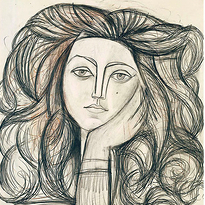

On September 15th, 2022, Heven launched its token, $HEVEN, with the community-driven social token platform P00ls, aiming at giving exclusive participative access to their universe. Ultimately, the disruptive token will help in collectively redefining creation and redistributing creative processes within the luxury industry and beyond, which is important for the founders and which is critically empowered by Web3. To understand the implications of such a mint, it is essential to dive into the cultural significance the brand is parallelly building.
The glass-blowing studio Heven, short for Home in Heven, was launched in 2020 by the models, creatives and multi-hyphenates Breanna Box and Peter Dupont. To grasp their creative universe, think Y2K candy-colors, manga mixed with astrology-forward references, and above all an endearing and candid lightness.
After releasing their first item, a devil-horned carafe, they “elaborated the name to ‘Home in Heven’ because (they) began branching out into other home items. And, at that time, (they) wanted to make (their) home heaven, because (they) were locked down,” Breanna told i-D.
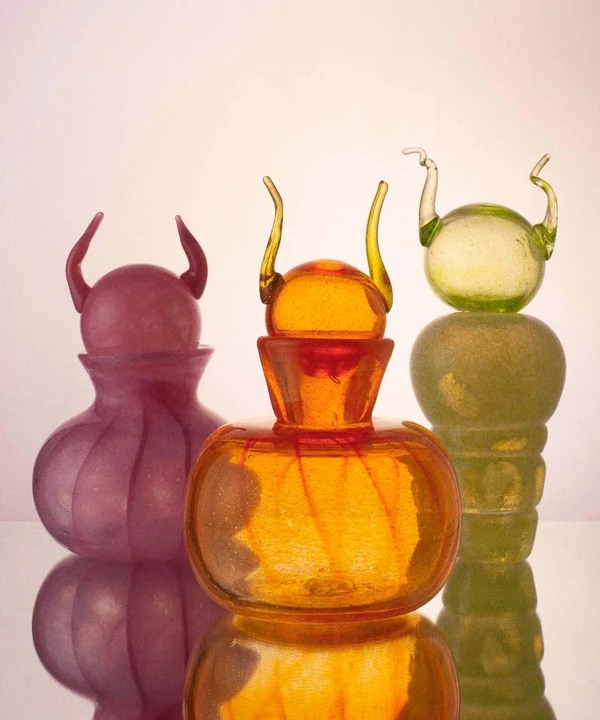
Home in Heven was founded after co-founder and model Breanna Box took a glass blowing class in New York City. She loved the enterprise so much that she drew her boyfriend Peter Dupont to pick up and learn the craft, traveling from London to The Glass Hub, in rural England, for several days onwards to fully immerse themselves in the learning process.
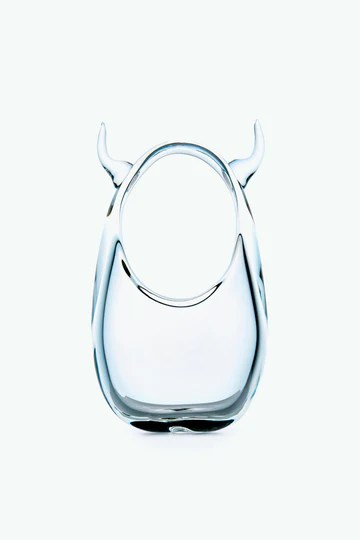
Initially featuring house items like tentacled vases, tulip-shaped wine glasses and signature devil-horned carafes, the couple is quickly expanding into other categories after their breakthrough collaboration with Coperni. Last March, they reinterpreted the rising Parisian label’s already iconic signature Swipe bag in a precious and sensual glass version, after Coperni’s co-founder Sebastien Meyer swiped into their DMs (pun intended) on Instagram. Coming down the runway in supermodel Gigi Hadid’s hands during the Paris Fashion Week they were an immediate hit, being worn by stars ranging from Doja Cat to the Kardashian.
Being pretty new to the craft, they are bringing youth and dynamism to a millennia-old practice associated with perfection and seriousness. “glass is such a bougie, old-lady thing: like, my grandma collects glass. It’s beautiful but it’s so untouchable, so it’s nice to infuse some youth and fun into it.” says Breanna (i-D). Their campaigns and items are cheeky and playful, “It’s super dangerous, yet very beautiful, fragile and all these weird opposites that I love about life.” Breanna told The Face, underlying the sense of tension defining their brand.
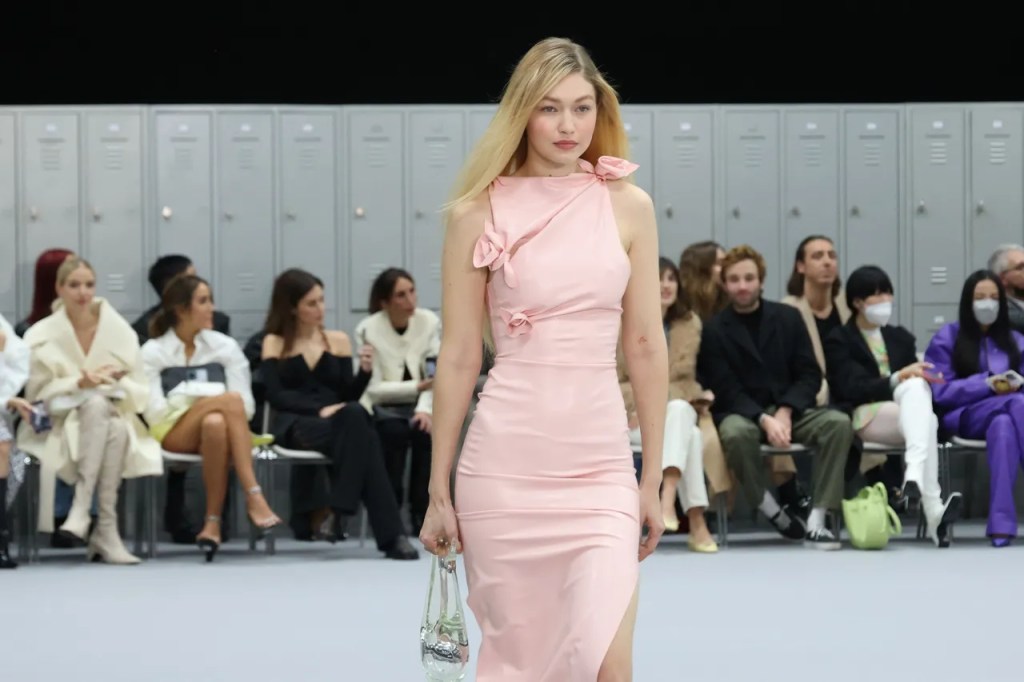

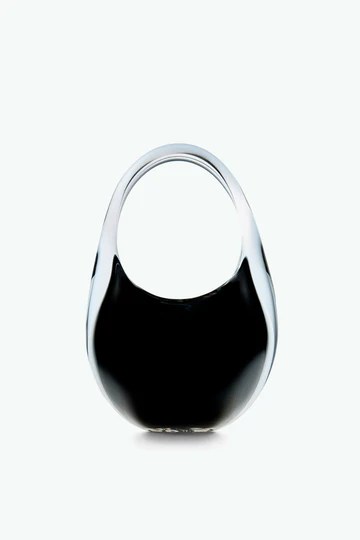
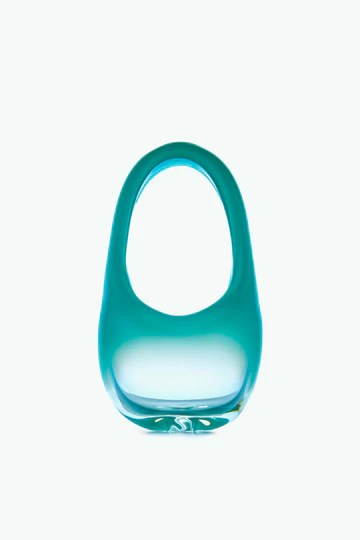
But why was the fashion sphere blown away (pun intended too), and why is it likely to continue to be the case? There are two aspects that cannot be ignored to explain the success of Heven: newness and originality first, and an understanding the current zeitgeist, but that is pretty standard of any newcomer making it in the fashion industry.
Most critically, their enterprise is unique to the extent that their use of glass pushes the limits between decorative art, fine art and pure consumerism. Indeed, the glass Swipe bag highlights the extreme tension between the precious functional accessory that the luxury bag is and the predominantly decorative, practical yet fragile, object that a piece of glassware is.
While they cite direct influence from the Bauhaus movement and the Memphis Milano founder Ettore Sottsass, and while their newest glassware release directly quotes Mondrian, they do not consider their craft as art. “I always have difficulty with this “art” thing, in terms of what we do. For me, art is something that doesn’t have a function. You can’t live in it, you can’t eat it; it’s just there and it has an aesthetic purpose. Our pieces always have a functionality and that’s one of the philosophies behind what we do with Heven. This bag is functional: you can put your phone in it, your wallet.” says Peter (i-D)
Clearly, the Heven x Coperni bag is an artistically driven accessory, but has physical delicacy taken priority over practicality, and, in fact, elevated an accessory to the rank of ultimate luxury: art that is consumed and enjoyed mainly if not only for its aesthetic value? These bags are beautiful, unique, precious, and made to order by hand. These are all quintessentially luxurious qualities, no doubt, but their fragility questions their legitimacy as regular bags, they certainly are something more, or at least different. That is why we are all intrigued.
To touch upon the long-lasting debate of the dichotomy between art and fashion, it is important to remember that the two creative enterprises have never been more intertwined. Cementing the mounting forces resulting from the 1980s during which fashion gained symbolic meaning in the popular imagination through the fusion of money, youth, and beauty as investigated by the art critic Roberta Smith in Vogue, Anna Wintour gave proper art historical significance to fashion, establishing her yearly Costume Institute exhibition as underlined by Georges Berges.
Additionally, the 1980s was the time of the emergence of performance art and minimalism, in which the engagement of the viewer was critical to the activation and entirety of the artwork, like in the work of American artist Carolee Schneemann. A fashion item, similarly, is only complete when worn.


Traditionally, though, there have been distinct categories of art. Namely, fine art, of which the only purpose is the achievement of aesthetic qualities, and which is often elevated as the purest form of artistic expression, that is, detached from the triviality of daily life and social constraints. Secondly, there is decorative arts, or crafts, which primarily serve a purpose even if their aesthetic quality gives them cultural and historical significance. Fashion is a craft. It is about extravagance and beauty, rather than comfort or functionality, but fashion, like fine art, enriches our lives with aesthetics. And finally, commercial art’s primary purpose is capitalist exchange and is often used in advertising.
While pop artists have blurred the line between commercial art and fine art, the line between decorative art – or crafts – and fine art while thin, is still critical. In fact, the elevated position attributed to fine arts in occidental culture is employed by fashion to raise the cultural capital of its creations. But to consume fashion items conspicuously and to engage with art self-effacingly shows a divide between materialist enterprise and subjective contemplation.

Yet, the Heven x Coperni bag is challenging this divide. In fact, the wearable art piece best falls into the decorative arts category. After all, one can still use this bag to store their belongings even if one is primarily struck by its aesthetic quality. But the very medium, that is glass, seriously questions the legitimacy of the practicality of the fragile object and therefore its utilitarian aspect.
Can an accessory be fine art begs this bulbous extremely desirable item? And therefore, can it create its own cultural capital enriching fine arts? Is a piece of art that can be used as an accessory the pinnacle of luxury? Or is it the other way around? Is this a form of cultural Renaissance where fashion becomes the cultural tastemaker instead of feeding from it?
The founders just launched their own line of glass-blown bags and glass jewelry where they keep exploring the tensions and definitions of creation and art. To support their ambition, they launched their token with P00ls, with which they intend to uplift and showcase other creatives in an organic manner, relying on community-building in the manner of a Decentralized Autonomous Organization (DAO) characteristic of Web3 and akin to a multidisciplinary studio.


With it, we are all invited to take part in the creative enterprise as they “grow-up in public” as the two founders put it for Another Mag. “We designed the first versions together with Josh Raiffe,” explained Dupont, speaking with HighSnobiety about the Coperni collaboration. “He’s one of the best glass blowers in NYC. To make them at the level they are now takes years of experience.”
Collaboration, therefore, is a core characteristic of their work and Web3 is an empowering tool. During an Instagram live with P00ls, Breanna expressed wanting to give access to the Heven universe even for people who cannot afford their items. “Everything high fashion, (most) people cannot have. I want people to feel fancy. I do not want them to have knock off versions. I want them to have something authentic.”
They are offering to have an exclusive, genuine access to their universe and unique opportunities to connect and collaborate in changing the fashion industry and participate in the wider cultural shift, into and beyond Web3, pushing the boundaries and questioning the limits of creativity, luxury, and unquestionably, art. The merging of fashion, art, and technology is part of a wider cultural shift towards collaboration and community-empowerment that is taking shape. What will not change however, is that the bold always gets the attention…
 mabou
mabou 
Leave a comment