As the cryptocurrency market is entering what is called a crypto winter, that is, a difficult time for all digital currencies as investors walk away from the unregulated assets pending a looming recession, the interest of luxury fashion brands for blockchain technology does not seem to fade away. Bitcoin, the most important crypto currency reached $19,000 in June from its all time high of $68,000 back in November 2021.That is a more than 2.5 times drop in value in less than a year.
But cryptocurrencies, albeit the most obvious and widespread use case for blockchain technology, is just one of the potential applications as demonstrated by the rise of NFTs. Critically, cryptocurrencies are treated like money, that is they are a store of value, unit of account, and medium of exchange. Their use case is rational and practical, and they are unregulated because they are fully decentralized. This makes it an extremely volatile asset.
While sharing some similarities with fungible tokens, like scarcity, traceability, digital ownership and uniqueness, NFTs have the potential to create real utility and cultural relevance, as well as a true sense of community, elements that are not only hard to quantify but also way less volatile than BTCUSD charts. In short, the use case potential of NFTs, excluding the speculative aspect, explains why brands are not shying away from investing into the space.
NFTs first came to light in 2021 as a way for artists and creatives to merchandise their digital works and retain control over the life of their digital assets, leading to the rise of resale platforms like OpenSea and SuperRare, fueling speculation, platforms which are also used by luxury brands to list their NFT projects. These platforms allow for trading, exchanging, and investing around art with seemingly limited utility for owners other than the collection aspect of owning these digital assets.
Brands are now starting to understand that NFTs need to be enhanced for their value to be sustained, and more importantly for a true sense of community to form around their products and brand’s identity. The digital sphere, metaverses and NFT projects are as much an opportunity for revenues than for marketing and engagement with and between customers.
Unlike traditional marketing, it can be engaging, targeted, and tailored by community members who decide how and how much they want to interact with a brand’s universe. What is at stake is visibility and cultural relevance to bring users into the fold of a brand’s universe, online and offline, with digital, physical and phygital products. Increasingly, traditional digital marketing channels are crowded, to the point where consumers cannot make sense of the noise and differentiate one brand from the other.
Because of its creative potential and ability to promote a full fledge universe tailored to a brand, the metaverse and other blockchain-based technologies (it is important to note that metaverse, Web3, and NFTs, albeit linked can exist independently from each other) can allow brands to have a better control over their digital identity and activate longer-term and more engaging strategies: gifts, events, podcasts accessible only to NFT holders for example.
Prada, the Italian powerhouse that does not need introduction, is among the companies who have not only experimented with the technology but has rolled out a consistent strategy to establish NFTs as part of their long term digital identity-building and merchandising strategy. After dipping in the space earlier this year through a collaboration with Adidas Originals which launched on Polygon, favored for its lighter environmental footprint, it made NFTs part of its Timecapsule project starting back in June. The Adidas project was a collaborative work driven by artist Zach Liebermann and featuring user-generated content and creator-owned art.
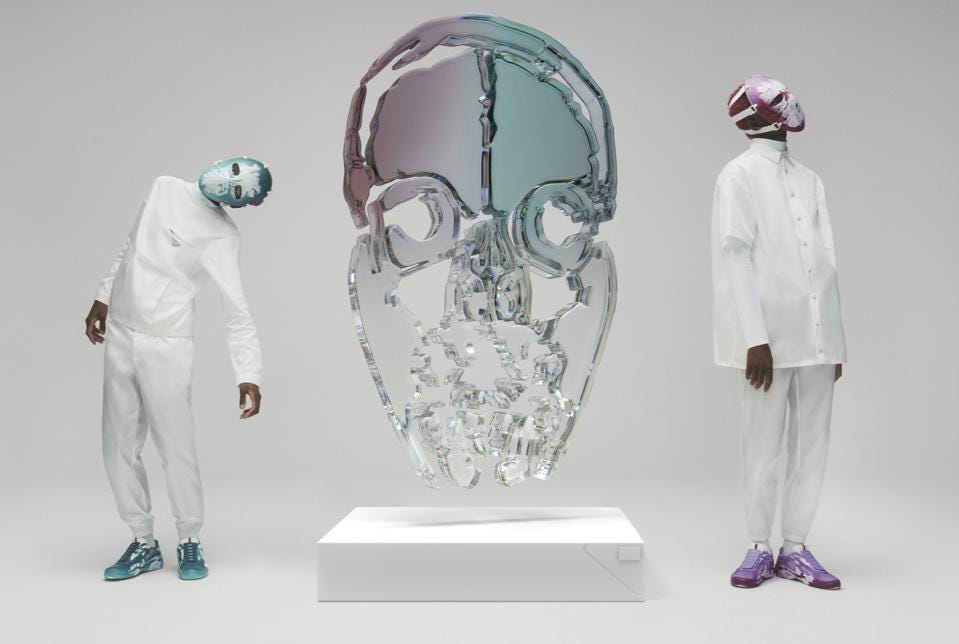
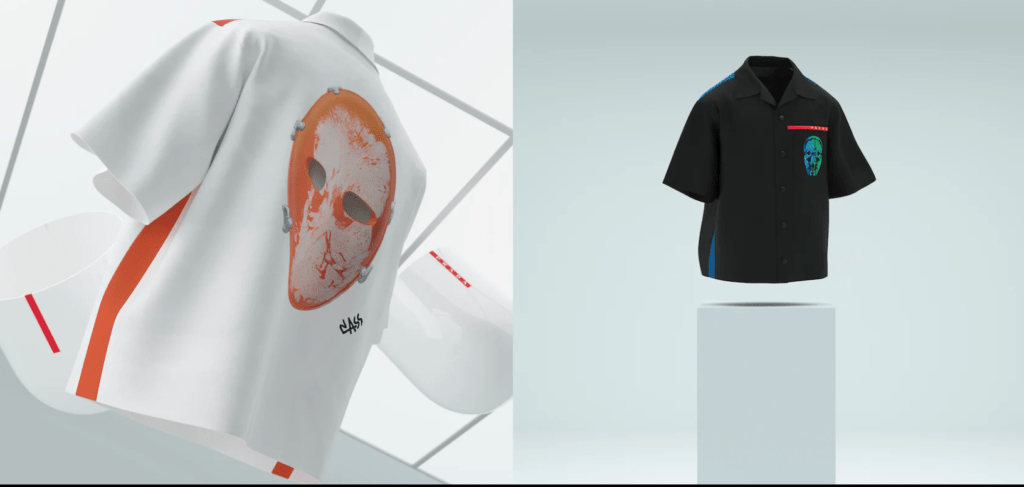
Each first Thursday of the month since December 2019, Prada drops an exclusive limited edition of 50 items, since June, it includes a digital twin, which seems to be one of the privileged alleys for fashion brands to establish their new online strategies, a way paved by RTFKT Studios. Quite interestingly, this first drop was made in collaboration with Cassius Hirst, son of Damien Hirst and featured black and white shirts showcasing the mask and brain scan signature of the artist.

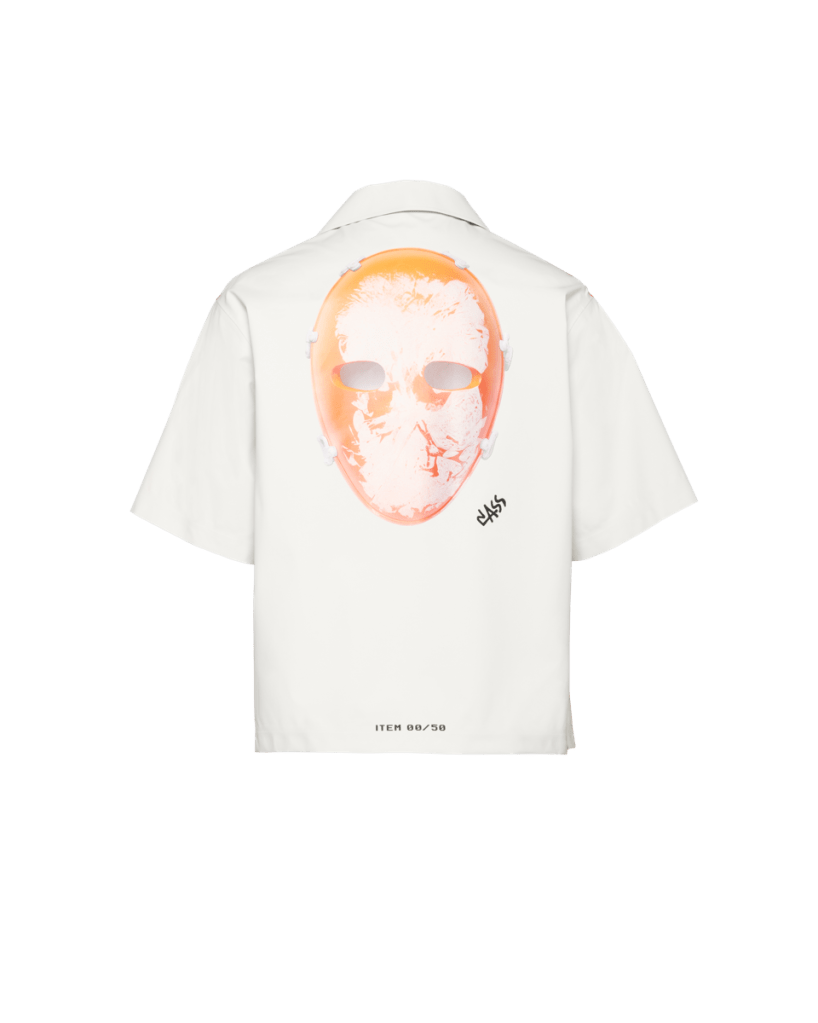
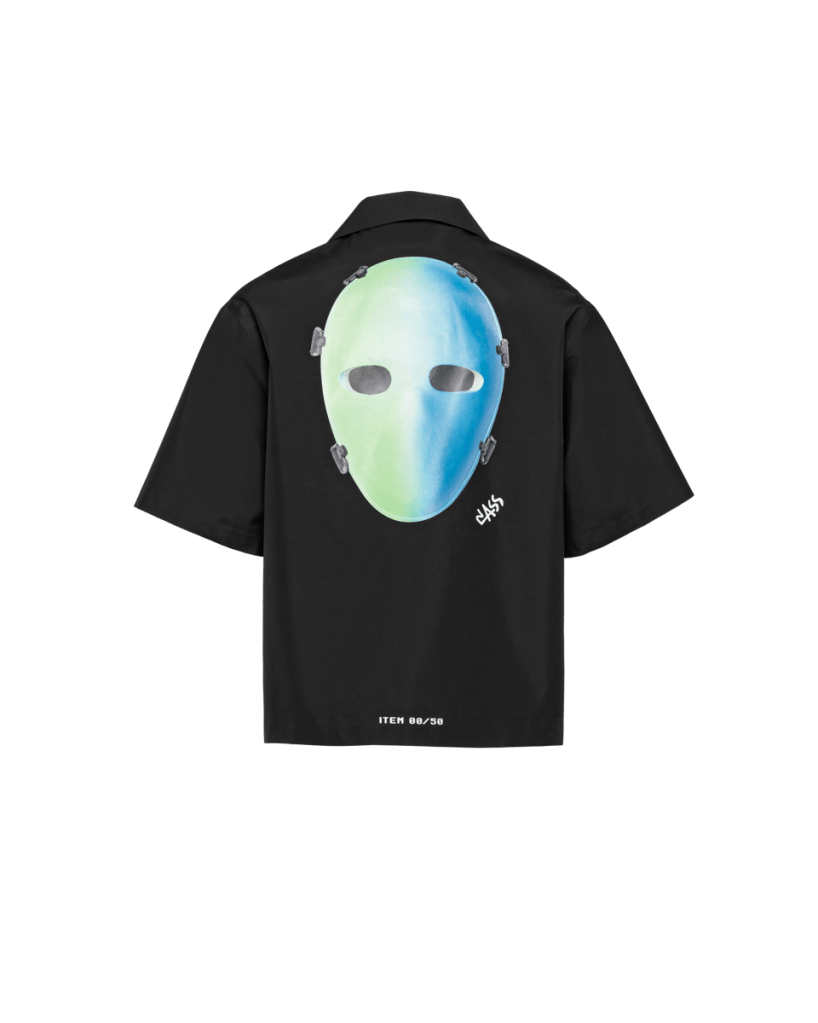
According to Artnet his logo, “represents hope and knowledge in a world of shadows and uncertainty.” This drop of 100 gender-neutral pieces, double the usual amount, was accompanied by a GIF NFT of a timecapsule minted on the Ethereum blockchain and facilitated by the Aura Blockchain Consortium, a non-profit founded by LVMH, Prada and Cartier.
The brand had already worked with the artist around the drop of physical sneakers back in May, but this digital foray points to the opportunity NFTs offers to put artists and digital collaborations at the center of luxury marketing strategy on a consistent basis, in fact changing the DNA of brands as they shift the creative process from the unique artistic directors to a community of artists and creatives (like in a DAO). According to Vogue Business, “There is a synergy between the Prada Timecapsule and the scarcity and desirability of NFTs,” Prada said in a statement.
Damien Hirst was in fact one of the first blue chip artists to ride the NFT wave, creating a collection called “The Currency” where buyers were asked to decide between the physical and digital version of the artwork in July 2021. This enterprise contributed in blurring the boundaries between art and culture and financial interests, between what is invaluable and what is purely monetary. This trend is not new in the art market but it seems to have intensified as fashion has taken part in attributing cultural importance to factory-replicated products.

Arguably, Donald Judd, one of the most famous artists of the twentieth century, was producing his works in factories while Warhol called his own studio “The Factory”, underlying the rising tension between the merchandising of art and the sanctity of culture which has supposedly no monetary price.
Akin to creating a fan base of admirators for artists, brands are creating communities of customers that adhere to the ethos of the brand and its historical significance within the cultural, and even art historical continuum as designers are presented as creative geniuses and trendsetters. In fact, what is at stake for marketing is creating an aura, which is an invaluable asset, to ultimately sell simple products. This ability to frame and control one’s story and public image through a tightly controlled distribution and communication channel powered by the blockchain enables brands to preserve their capital of exclusivity, which they struggle to do in Web2.
Critically, this is not a one time event for Prada, although each drop does not feature a collaboration with an artist, Prada is inscribing its use of NFTs into the long-term. To sustain the interest and the value of these assets, which are already re-sold on OpenSea, the holders will have access to exclusive perks and privileges that Prada has not yet unveiled, to build loyalty. They have also opened a Discord channel, “Prada Crypted”, to interact with their community, open to non-NFT holders.
While linking it to an already existing merchandising strategy, because of the price point (around $1,000) and limited drop nature of the assets, democratization of access is not the point, rather, Prada is trying to bring its already loyal customers into the Web3 ecosystem while the opportunity for resale is addressed to a more Web3 native audience.
Because of the exclusivity and the intrinsically limited number of holders, this cannot only be a revenues-oriented strategy but a marketing strategy. According to many actors, it is for the moment the best way to set foot into Web3. In fact, brands that have not yet rolled out NFT strategies might end up paying the price a few years down the line when mass adoption is here. It might be sooner than we all think.
 mabou
mabou 
Leave a comment