
Collection is, by nature, multifaceted and encompasses several medium of artistic expression. For example, fashion, as testified by the ever-expanding number of items hitting the market, is prone to the phenomenon of collection. It is also a prone medium of artistic expression as testified by the work and personality of the famed Interior Designer Kelly Wearstler, based in Los Angeles. It can be argued that her job is all about forming and curating collections of objects, a dynamic she also expresses through a deeply personal sense of fashion, claiming “I dress how I design”, “I love texture. I love things that are raw and refined. I love contemporary fashion designers but I also love incorporating vintage.” she says.
The multi-hyphenate creative thrives in blending and mixing references and mediums. She is always keen on exploring and collaborating, and one of her recent projects hints towards one of the new directions she is taking as her studio created a hyper-realist cyber-garage for LeBron James’s all-electric GMC Hummer EV… only available in the digital realm.

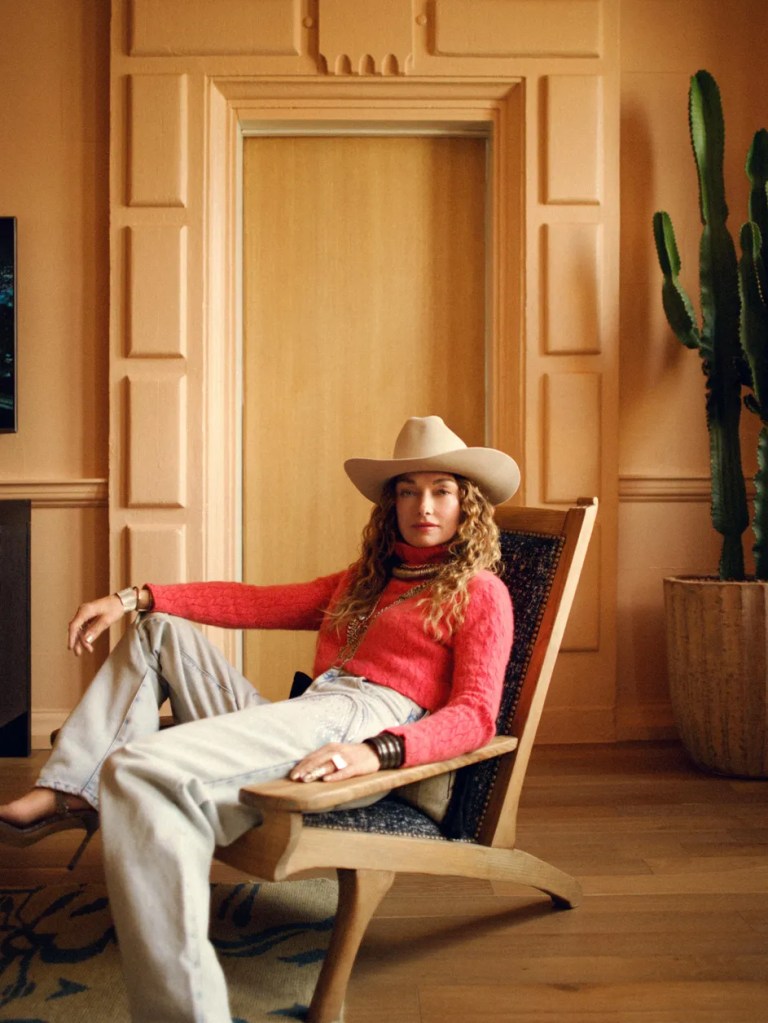


I caught up with Ceren Arslan, digital designer and member of Wearstler’s close team to better understand the impact of the rise of the digital for interior design, architecture, and the intersection of the different creative spheres Arslan and Wearstler both take inspiration from, and how this medium allows for an even greater creative freedom. In turn, I look at what it means for the process of personal collection building.
Looking at architecture, design, art and fashion, which by no means exhaustively encompass every form of visual creation, a digital piece allows creativity beyond the material limitations. For example one can create fashion from unconventional fabrics or digital houses sold as NFTs, allowing one to create portfolios of items that have both display and utility value within a new value system questioning our engagement with art and creation at large.
Ceren Arslan has been dipping into the space since 2019, when she graduated from Pratt Institute, and keeps exploring it working on her EXIT series. In her own words, “EXIT is a digital rendering series which investigates how shared digital data can influence the culture of the image-making of an architectural space, its aesthetics and representation.” “They are hyper-real. They are exits into fictional realities.” that allow her to reference existing elements while challenging our sense of reality with unexpected details.


Ceren has a background in traditional architecture, working for three years in a corporate environment on commercial projects where she quickly took the lead in proposing digital 3D renderings of projects that would later on be drawn physically, pioneering the reversing of the traditional process of architectural conception. About a year and half ago, as her creative fiber was not fully satisfied, she started the EXIT series that have now taken on a life of their own. Six months ago, she emailed Kelly and moved to LA to develop the digital projects of the designer’s studio.
When it comes to her creation of the EXIT series, Ceren tends to take a top-down approach rather than a bottom-up one, although this is not a rule of thumb. She mentions she treats it as a journal, she thinks of a concept, executes and iterates messing around with volumes and masses until she finds it right, shares it and does not go back to it. Design, she says, informs textures as she focuses on creating architectural drama. Usually, she keeps it monochromatic not to distract the attention of the viewer as the focus is on the spatial quality.

She imagines a concept and a general aura before getting into the details of the materials, fabrics and objects. Architectural composition is the main focus and the way the eye travels informs the way she builds images. For example, for the Ultimate Dinner Table, she was driven by creating a space prone to a large dinner, before getting into the relatable elements like imperfections, stain or mold for the viewer to be grounded in a sense of reality. Then, she mixed unexpected elements like the busts to create an alternative reality.
As she is starting to explore video-making, she cites cinematic references like the sophistication of Wes Anderson (especially the Grand Budapest Hotel) for whom colors, plans and the way the camera travels within a space are quintessential. Each of his plans are images that deserve to be framed on their own and every detail participates in creating a hypnotical experience for the viewer.




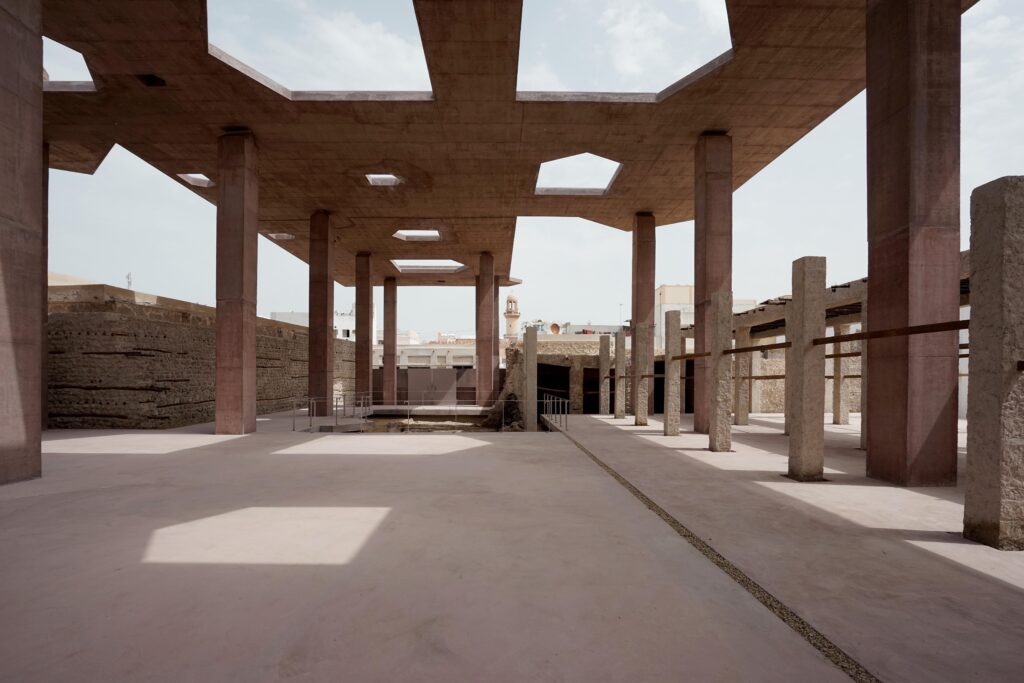
Other references she cites as informing her practice are John Lautner, a student of Frank Lloyd Wright interested in the relationship between human living and nature as testified by the organic curves of his quintessentially Californian buildings. Others are Riccardo Bofill, Oscar Niemeyer and Valerio Olgiati, all at the intersection of a rough, brutalist and modern architecture and a conscious effort to create harmonious structures adapted to the contemporary urban way of life, and above all, concerned with designing structures that would last through time. Specifically, for the Holy Bathtub, she was inspired by Tadao Ando’s Church of Light and especially the way the light comes in through the transept in a final moment of glorification.


EXIT, she says, is an all encompassing passion project in constant development as she participates in collaborations she hopes to scale. The chairs in her Ultimate Dinner Table EXIT were designed by Maz, and her most recent work was done in collaboration with Pietro Franceschini, a creative designing collectible furniture. The pair had been trying to work together for some time but it took her seeing Waldo W1 and falling in love with the design to come up with a project that felt true to her, and her relationship with Pietro.
Indeed, for Ceren, EXIT is not only about digital design, it is a lifestyle, a brand part of her personality, it is an opportunity to exit an uncomfortable situation, to catch a plane to escape our sense of responsibility and reality. It is not about label or trend, It is a creative character and persona that also includes her sense of, and interaction with, fashion. She has deep admiration for Diana Vreeland, the former Editor in Chief of Vogue, for the magazine itself, and of course, for Kelly Wearstler. She also cites out-of-the-box Japanese fashion designers and their focus on cut, shapes and the framing of the body akin the architectural creations. EXIT is a way for her to gain ownership within an industry that is traditionally extremely hierarchical.


When it comes to her personal style, consistency defines her allure, she tells me the sunglasses have become a signature, paired with boots and classic pants, because it is the way she best expresses her personality. In fact, fashion is about being in line with one’s creative world. “She is so EXIT” she says about Kelly, because she mixes and matches, unconventionally pairs and seems to have an outfit for every situation which are as many creative bubbles within her mind. EXIT’s fashion is about communicating one’s creative language through clothes, it is about expressing it, and getting it at the same time, whatever your personal it is.
Parallely, her work with Kelly allows her to discover new artists, designers, and creatives on a daily basis by doing a large amount of extremely detailed research on anything and everything from glassworks to jewelry. As she immerses herself into her mentor’s creative process and character, putting together things that do not seem to make sense but actually do (both in terms of fashion and interior design), Ceren expresses how inspirational the experience is since everything remains subconsciously there when she creates.


Since joining Kelly, she has been working on the pipeline of digital projects the studio has been putting together, adding a new dimension to Wearstler’s creative capabilities focused on Web3 and developing a new unique digital language and identity. If no specific project were discussed during our interview, Ceren confirmed that NFTs and metaverse projects were at the forefront when it comes to scaling and adjusting Wearstler’s practice.
Discussing the future of Web3, Ceren agreed that the word NFT is oversaturated these days but she is a fan, she thinks it is the future of transactions, communication, and design. Yet, the challenge remains in creating value for all stakeholders in the art world. There is a discrepancy between minting, that is creating numbers and codes that are added to the blockchain and its social use for the creative industry. Some projects are more successful than others but it is an everyday learning experience, for her, and for all of us. For now it is certainly a powerful way to store and display her work, as well as to reach a broader audience.
Understanding Arslan’s variety of creative references, it is no surprise she found common ground with Kelly Wearstler. Their creative process, both in terms of visual language and technical expertise, shows how the digital world is gaining in popularity, legitimacy and quality. Wearstler is “drawn to creatives who are somewhat subversive or challenge the status quo“ and takes pride in showcasing young and new voices. It shows that the digital space is expanding mediums of display, audience, and objects of study, bending and collapsing the traditional boundaries between artforms even more than before.
What makes Wearstler unique is her ability to collide different references and styles to create a sense of harmony in her own terms. Her cross interpretation of interior design, art – she owns a Victor Vasarely she cites as an inspiration – and fashion reflects the multiplicity of her inspirations and the quirkiness of her style, taking inspiration both from past and present, in terms of furniture and fashion. She cites Pierre Cardin, Oscar Niemeyer (too), Carlo Scarpa, Louis Kahn, Gio Ponti and Carlo Mollino as main sources of inspiration.

Kelly Wearstler’s home, courtesy of Kelly Wearstler 
Kelly Wearstler’s home, courtesy of Kelly Wearstler 
Kelly Wearstler’s home, courtesy of Kelly Wearstler. Vintage Dolores chairs by dutch designer Rob Eckhardt by the window, real wall painting by Len Klikunas 
Kelly Wearstler’s home, courtesy of Kelly Wearstler, Utrecht chairs by Dutch architect Gerrit Rietveld
As underlined by The New Yorker, “Her choices are governed by instinct rather than by intellect.” She uses bold colors, patterns, and unique fabrics that would not necessarily be expected in a home. Her interiors are reminiscent of the effervescence and eccentricity of the West Coast, sunbathed in Hollywood extravaganza. Her portfolio encompasses both commercial – a number of projects she has done in collaboration with the Kor Group owned by her husband – and residential. She also finds that her most successful projects are the ones in which the client is deeply involved, and where she is able to translate a voice in her own creative language.
Speaking to ArtNet, she underlines that art and design are colliding more than ever before, giving the example of Ettore Sottsass’ works (I am personally dying for this wavy Ultrafragola mirror seen all over social media, and dating originally from the 70s!) that are art pieces by themselves. To differentiate art and design, she personally draws the line as function, although I would argue that “aesthetically pleasing” is a function enough.

Wearstler, therefore, is the quintessential example of a collector. Creatives, in fact, often collect items themselves, as future references and sources of inspirations informing their personal creative process, like Wearstler describes in Coveteur.
The phenomenon of collection has been observed in societies along the development and solidification of art production, but these collections differ from the modern enterprise in at least two aspects: what we now label as art only came to be recognized as such as the category of “aesthetic art” came to gain ground. For example, much of the cultural artifacts found in Mesoamerica had a primary practical use before being attributed display value within Western collections and eventually museums. Secondly, collections used to be assembled by a community of patrons rather than individuals, and linked to an institution: the Crown, the Church, or any form of temple for the most part.
The modern phenomenon of Western collection, that is, the personal quest for aesthetical harmony, started to develop during the Italian Renaissance, culminating in the 16th and 17th centuries with the multiplication of wunderkammers, or Cabinets of Curiosities. These included a variety of natural and artificial artifacts of any forms, only related to each other in as much as their owners thought to create a conversation between them. What made cabinets of curiosities so interesting was their eclecticism and the window it opened into cross-interpretations, without rational structure. They were creations in their own right as much as the objects within them were.


As the political, social and cultural landscape evolved and the democratic states took culture into their hands, these private collections formed the basis of public museums, but as argued by Walter Benjamin in Unpacking My Library, “one thing should be noted: the phenomenon of collecting loses its meaning as it loses its personal owner.”
In fact, collection at its core is a highly personal enterprise allowing the owner to express herself in relation to time and to the world around us. In System of Collecting, Jean Baudrillard dives into the meaning and characteristics of collection building. For him, collectibles of any form “by virtue of their being inserted into mental sets, allow one to establish dominion over time, interrupting its continuous flow and classifying its parts.” explaining why “a single object can never be enough: invariably there will be a whole succession of objects” and “the collection is never really initiated in order to be completed”.
Objects, according to the Littré are “Anything which is the cause or subject of a passion. Figuratively and most typically: the loved object” and become part of someone’s personality and way to exist in relation to others. Indeed, “that one peculiarity of the object, its exchange value, is governed by cultural and social criteria. And yet, its absolute singularity as an object depends entirely upon the fact that it is I who possess it — which, in turn, allows me to recognize myself in it as an absolute singular being.”
Therefore, the expansion of collectibles within the digital space participates in extending the possibilities of collection, and in turn personal definition through a shift of cultural and social criteria. Figures like Wearstler, by working with digital designers like Arslan, diving into the space, legitimize the metaverse and its capacity in truly revolutionizing the creative and collection processes. It creates a new piece of identity-building, a new layer one can add, shifting our cultural conversation online and our societal mechanism of attributing, understanding, and creating value within the creative space. So, are you ready to EXIT?
 mabou
mabou 
Leave a comment